MCP server · Developer tools
Altium Designer MCP server
Let your AI build and edit Altium footprint and symbol libraries for you.

This is a helper that lets your AI assistant create and change Altium Designer component libraries. It works with the .PcbLib files that hold footprints and the .SchLib files that hold symbols. It is handy if you build or look after Altium parts libraries and want the AI to do the slow, repetitive parts.
What is an MCP server? The 30-second version
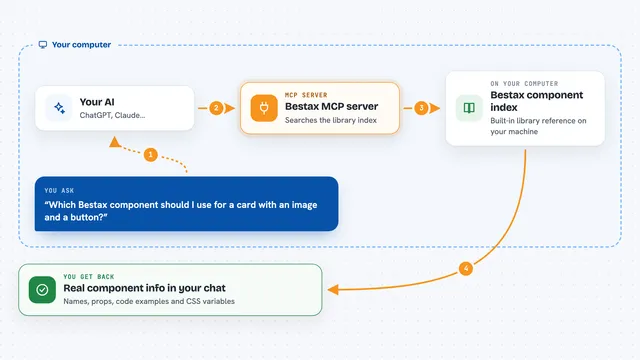
On its own, your AI can only chat. An MCP server is a small helper program that gives your AI a new skill or a connection to an app. This one connects your AI to Altium Designer library files, so it can read and write .PcbLib and .SchLib files for you. You ask in plain words, and the AI does the thinking while this helper does the file work.
What this MCP server does
You tell your AI what part you want, such as a 0603 resistor or a new connector. The AI works out the pad sizes, courtyards and silkscreen using standard rules, then asks this helper to write the footprint and symbol into your library files. The helper reads and writes the actual Altium files, places the pads and shapes, and can attach 3D STEP models. When it is done, you get a real library file that Altium can open, plus a short summary in the chat.
 Click to zoom
What you can do with it
- Create new footprints and symbols from a description
- Read and list what is already inside a library
- Update a pad, a shape or a whole component in place
- Compare two libraries or two components to spot differences
- Copy, rename, merge or delete components
- Validate a library and clean up leftover data
- Export a library to JSON or CSV, and import it back
Try asking your AI
- “Create a 0603 resistor footprint and symbol in my library”
- “List all the components in my PcbLib file”
- “Change pad 1 of the SOIC-8 footprint to a rectangle”
- “Compare these two libraries and tell me what changed”
What it gives back to you
You get plain answers in the chat, like a list of component names, a summary of what was written, or a short preview of a footprint drawn as text. It can also hand back exported files in JSON or CSV, and it can pull out embedded STEP 3D models. When it changes something, it tells you what it changed.
Before you start
What you need
- An MCP-capable AI assistant such as Claude Desktop or Claude Code
- Altium Designer library files (.PcbLib or .SchLib) to work on
- On Windows, macOS or Linux, the prebuilt program from the Releases page
Good to know
It can change, rename or delete components in your library files, so keep a copy or use its backups before big edits.
Install it with your AI
Add Altium Designer MCP server to your AI, no technical skills needed
You don't install anything by hand. You copy one prompt, paste it into an AI that can work on your computer, and it checks, installs and connects the server for you, asking you when it needs something.
Sign in to get the install prompt
Members get a ready-made prompt that lets the Claude desktop app check Altium Designer MCP server, install it and connect it for them, step by step. You don't need any technical skills: you copy, paste and answer a few questions. Your connected AI can also find and install any of the 4,361 MCP servers here for you.
Who it's for
People who build or maintain Altium Designer component libraries, like electronics engineers and PCB librarians.