MCP server · API · official
Apache APISIX MCP server
by api7 · official
Let your AI look at and change the settings in your APISIX gateway using plain English.
This is a helper that connects your AI assistant to Apache APISIX, a tool that sits in front of your websites and apps and decides where incoming traffic should go. Once it is set up, you can ask your AI to show you what is configured or to make changes, instead of clicking around in a separate admin screen. It is handy for people who run or look after web services and want a quicker way to check things.
What is an MCP server? The 30-second version
On its own, your AI can only chat with you. An MCP server is a small helper program that gives your AI a new skill or a connection to another app. This one connects your AI to APISIX, so the AI can look up what is set up there and make changes for you when you ask. You stay in the chat, and the helper does the back and forth with APISIX behind the scenes.
What this MCP server does
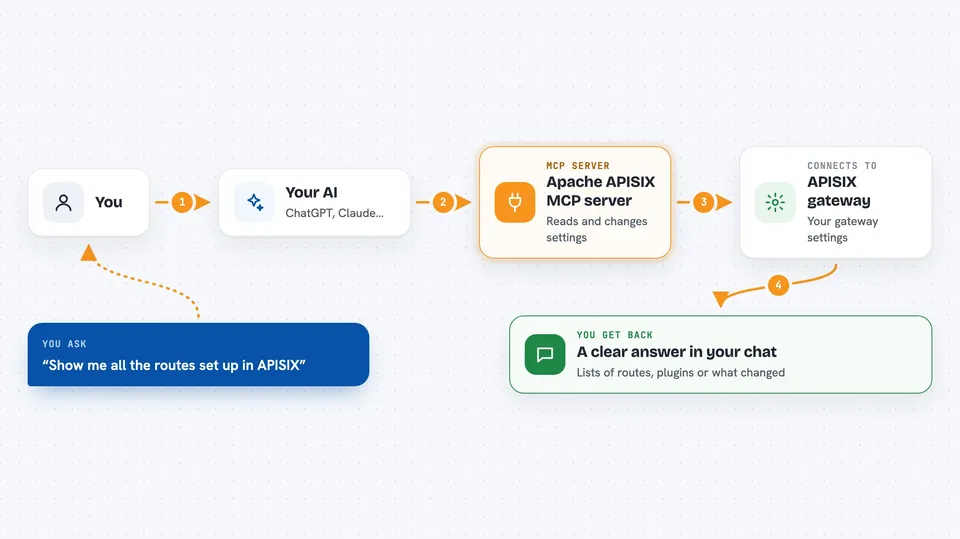
You type a request in plain words, like asking what routes exist or asking to add a new one. Your AI reads that and uses this helper to talk to the APISIX Admin API, which is the part of APISIX that manages its settings. The helper sends the request, APISIX answers, and the helper passes the answer back to your AI. Your AI then shows you the result in the chat, or tells you what it changed. You never have to touch the admin screen yourself.
 Click to zoom
What you can do with it
- List the routes, services, and upstreams set up in your APISIX gateway
- Add a new route and point it at a service you already have
- Update or delete an existing route by its ID
- Look up which plugins are available and what settings they take
- Manage SSL certificates used by your gateway
- Create or update consumers and their credentials
- Send a test request through the gateway to see what happens
Try asking your AI
- “Show me all the routes currently set up in APISIX”
- “Add a new route called my-api that forwards to my upstream service”
- “What plugins are available and what does the limit-count plugin need?”
- “Delete the route with ID 1”
What it gives back to you
You get answers in the chat: lists of routes, services, or plugins, and the details of each one. When you ask it to change something, it tells you what it created, updated, or removed. For test requests, it shows you what the gateway sent back, like a status code or a short response. Everything appears as text you can read and copy.
Before you start
What you need
- An APISIX server that is already running and reachable from your computer
- The Admin API key for that APISIX server (a kind of password; it is set when APISIX is installed)
- The host, port, and admin port of your APISIX server
- An AI client that supports MCP, like Claude Desktop, Cursor, or Copilot
Good to know
This helper can create, change, and delete things in your live APISIX gateway, so be careful with requests that remove or rewrite settings.
Install it with your AI
Add Apache APISIX MCP server to your AI, no technical skills needed
You don't install anything by hand. You copy one prompt, paste it into an AI that can work on your computer, and it checks, installs and connects the server for you, asking you when it needs something.
Sign in to get the install prompt
Members get a ready-made prompt that lets the Claude desktop app check Apache APISIX MCP server, install it and connect it for them, step by step. You don't need any technical skills: you copy, paste and answer a few questions. Your connected AI can also find and install any of the 4,361 MCP servers here for you.
Who it's for
Developers, DevOps engineers, and platform teams who run an APISIX gateway and want to check or change its settings from their AI chat.