MCP server · Finance and crypto
Agent Payments Intelligence MCP server
by goodmeta
Lets your AI scan GitHub, Hacker News and npm for new agent payment activity and hand you a scored list of opportunities.
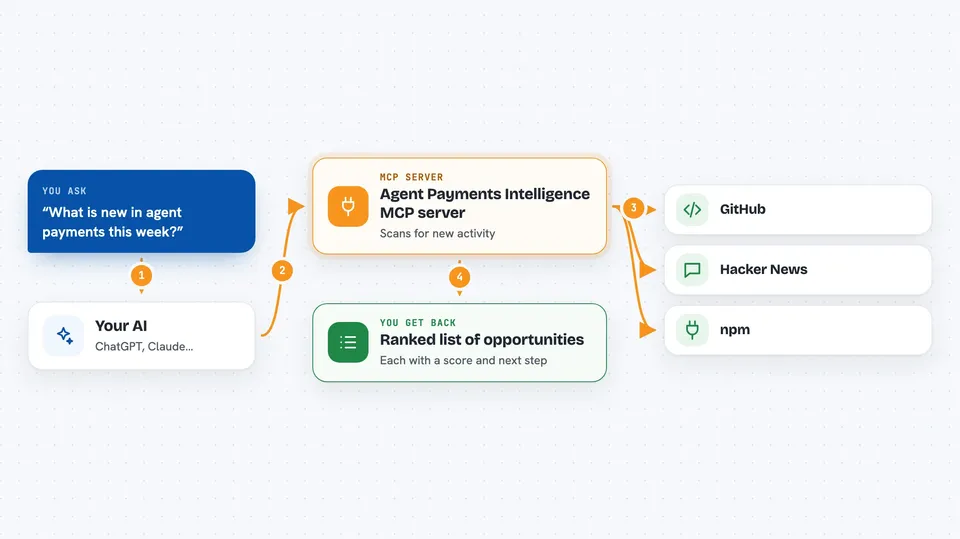
This is a small helper that gives your AI a way to keep an eye on the fast-moving world of agent payments. It looks through GitHub, Hacker News and npm for new projects, packages and discussions, then sorts them into a short list of things worth your attention. It is handy if you follow this space for work and do not want to check five sites by hand every morning.
What is an MCP server? The 30-second version
On its own, your AI can only chat with you using what it already knows. An MCP server is a small helper program you connect to it, and that helper gives your AI a new skill or a link to an outside service. This one links your AI to agent payments news and code sources, so it can go look things up there for you. When you ask a question, your AI passes it to this helper, the helper does the searching, and the answer comes back into your chat.
What this MCP server does
You ask your AI something like what is new in agent payments this week. Your AI sends that request to this helper. The helper then scans GitHub for new repos, Hacker News for related stories, and npm for new packages, using keywords tied to five agent payment protocols. It classifies what it finds and gives each item a score. Your AI shows you the results as a ranked list you can act on.
 Click to zoom
What you can do with it
- Scan for new agent payment projects and discussions from the last few days
- Get a scored list of opportunities with a suggested next action for each
- Look up the basics of a single protocol, like who made it and what layer it sits on
- Compare all five protocols side by side on things like budget limits and MCP support
- Spot new npm packages tied to these protocols
- Filter results by a minimum score so only the strongest signals show up
Try asking your AI
- “Scan for agent payment opportunities from the last 7 days”
- “What is new in x402 this week”
- “Compare AP2 and ACP for me”
- “Tell me about the MPP protocol”
What it gives back to you
You get back a ranked list of findings, each with a score, a short label like contribution or prospect, a one-line reason, a suggested action, and a link. For protocol questions you get a short description or a comparison table. Everything shows up as text in your chat, so you can read it, copy it, or ask follow-up questions.
Before you start
What you need
- A GitHub personal access token (a kind of password for GitHub; you can create one in your GitHub settings)
- An Anthropic API key (a password for the AI service; you get one from Anthropic)
- Node.js installed on your computer
- A small amount of USDC for the paid scan tool
Good to know
The scan tool costs a small amount of USDC each time you run it, so keep an eye on how often you use it.
Install it with your AI
Add Agent Payments Intelligence MCP server to your AI, no technical skills needed
You don't install anything by hand. You copy one prompt, paste it into an AI that can work on your computer, and it checks, installs and connects the server for you, asking you when it needs something.
Sign in to get the install prompt
Members get a ready-made prompt that lets the Claude desktop app check Agent Payments Intelligence MCP server, install it and connect it for them, step by step. You don't need any technical skills: you copy, paste and answer a few questions. Your connected AI can also find and install any of the 4,361 MCP servers here for you.
Who it's for
People who track the agent payments space for work, like product folks, analysts, founders and developers keeping an eye on new protocols and tools.