MCP server · Finance and crypto
Bitcoin UTXO MCP server
by kukapay
Lets your AI look up Bitcoin address balances and block details for you.
This is a small helper that connects your AI assistant to Bitcoin data on the blockchain. Once it is set up, you can ask your AI about a Bitcoin address or a specific block, and it will fetch the numbers for you. It is handy if you follow crypto news, write about Bitcoin, or just want to check an address without opening a block explorer.
What is an MCP server? The 30-second version
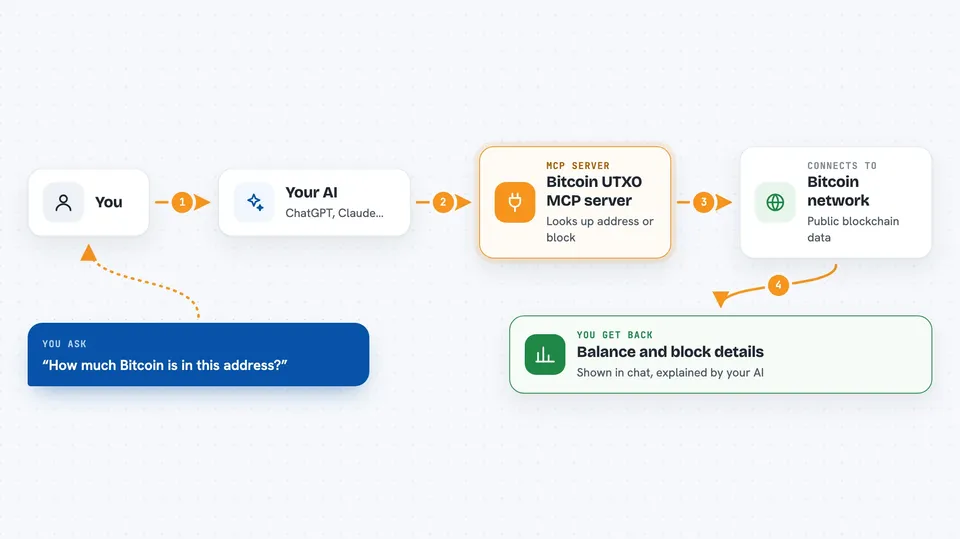
On its own, your AI can only chat with you using what it already knows. An MCP server is a small helper program that gives your AI a new skill or a connection to an outside service. This one connects your AI to Bitcoin blockchain data. When you ask a question about a Bitcoin address or a block, your AI passes the request to this helper, the helper fetches the data, and your AI explains it back to you.
What this MCP server does
You ask your AI something like how much Bitcoin is sitting in a certain address. Your AI sends that address to this helper. The helper looks up the unspent outputs (the chunks of Bitcoin that address can still spend) and the total value. You can also ask about a specific block by its number, and the helper returns the block hash, how many transactions are in it, the total value moved, and the time it was mined. The AI then shows you the results in the chat and can help you make sense of them.
 Click to zoom
What you can do with it
- Look up how many unspent outputs a Bitcoin address has
- See the total Bitcoin value held at an address
- Check the transaction count and total value in a specific block
- Get the hash and timestamp of a block
- Ask the AI to analyze Bitcoin funds flow and network health using the data
Try asking your AI
- “Show me the UTXO details for the Bitcoin genesis address 1A1zP1eP5QGefi2DMPTfTL5SLmv7DivfNa”
- “What's the transaction data for the Bitcoin genesis block?”
- “How much Bitcoin is sitting in this address: 1A1zP1eP5QGefi2DMPTfTL5SLmv7DivfNa”
- “Analyze Bitcoin funds flow and network health based on recent UTXO and block data”
What it gives back to you
You get back plain text with the numbers and details, shown right in the chat. For an address, that means the number of unspent outputs, the total value in BTC, and a list of the individual outputs with their transaction IDs and confirmations. For a block, you get the block hash, transaction count, total value, and block time. The AI can then summarize or explain any of it for you.
Before you start
What you need
- Python 3.10 or newer installed on your computer
- The uv package manager (a free tool for running Python programs)
- An MCP-compatible app such as Claude Desktop
Good to know
The data comes from an outside blockchain service, so it can be delayed or wrong, and this is not financial advice.
Install it with your AI
Add Bitcoin UTXO MCP server to your AI, no technical skills needed
You don't install anything by hand. You copy one prompt, paste it into an AI that can work on your computer, and it checks, installs and connects the server for you, asking you when it needs something.
Sign in to get the install prompt
Members get a ready-made prompt that lets the Claude desktop app check Bitcoin UTXO MCP server, install it and connect it for them, step by step. You don't need any technical skills: you copy, paste and answer a few questions. Your connected AI can also find and install any of the 4,609 MCP servers here for you.
Who it's for
People who follow Bitcoin or crypto and want quick answers about addresses and blocks without opening a block explorer, plus anyone curious about on-chain data.