
MCP server · Research
Trustpilot Reputation MCP server
by mambalabsdev
Look up a company's Trustpilot rating, review count and claimed status from its domain.
This is a small helper that lets your AI look up how a company is rated on Trustpilot. You give it a company website address, and it comes back with the score, the number of reviews and whether the profile is claimed. It is handy if you check suppliers, partners or competitors and want the numbers without opening a browser tab.
What is an MCP server? The 30-second version
On its own, your AI can only chat with you. An MCP server is a small helper program that gives your AI one extra skill. This helper connects your AI to Trustpilot, so when you ask about a company, the AI can go and fetch that company's rating and review numbers for you. You stay in the chat and just read the answer.
What this MCP server does
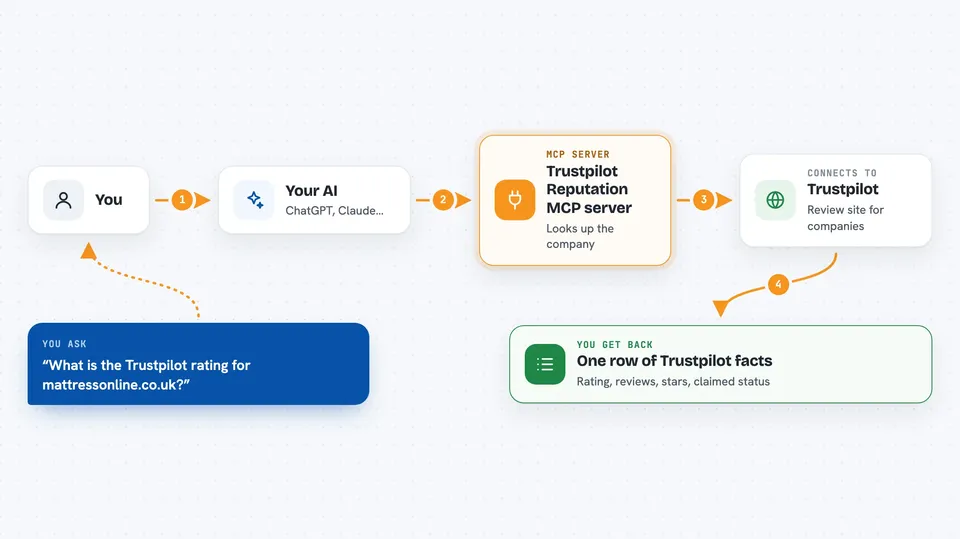
You ask your AI something like what is the Trustpilot rating for this website. The AI passes the domain and your Trustpilot key to this helper. The helper runs a lookup on Apify, which talks to Trustpilot's business units service. The result comes back as one flat row of facts, and the AI shows it to you in the chat. If something could not be read, the row says so instead of showing a fake zero.
 Click to zoom
What you can do with it
- Get the Trustpilot rating and total review count for a company domain
- See the full one to five star breakdown, not just the average
- Check whether a company's Trustpilot profile is claimed and verified
- See which Trustpilot categories a business is listed under
- Flag whether a rating is backed by enough reviews to be meaningful
- Reuse a recent lookup from cache instead of fetching again
- Get a clean one-row result you can paste into a spreadsheet
Try asking your AI
- “Get the Trustpilot rating for mattressonline.co.uk. Here is my Trustpilot key.”
- “What is the star breakdown for this company on Trustpilot?”
- “Look up this domain's Trustpilot reputation and flag it only if it has at least 100 reviews.”
- “Is this company's Trustpilot profile claimed and verified?”
What it gives back to you
You get one flat row of facts about the company, with the rating, review count, star breakdown, claimed status and categories. It also tells you how the profile was found and whether the rating had enough reviews behind it. In the chat this usually shows up as a short list or a small table you can read at a glance. If a lookup could not be done, the row says blocked, not found, not extractable or skipped instead of a number.
Before you start
What you need
- Node.js 18 or newer
- A free Apify account with an API token
- Your own Trustpilot API key, free to create at developers.trustpilot.com
Good to know
It needs two keys to work, your Apify token and your own Trustpilot API key, and lookups run on Apify so they may count against your Apify usage.
Install it with your AI
Add Trustpilot Reputation MCP server to your AI, no technical skills needed
You don't install anything by hand. You copy one prompt, paste it into an AI that can work on your computer, and it checks, installs and connects the server for you, asking you when it needs something.
Sign in to get the install prompt
Members get a ready-made prompt that lets the Claude desktop app check Trustpilot Reputation MCP server, install it and connect it for them, step by step. You don't need any technical skills: you copy, paste and answer a few questions. Your connected AI can also find and install any of the 4,609 MCP servers here for you.
Who it's for
People who check companies before working with them, like sales researchers, procurement staff, marketers and analysts comparing suppliers or competitors.


