MCP server · Email
OpenAgentEmail MCP server
Give your AI its own email address so it can send, read, and wait for messages on your own domain.

OpenAgentEmail is a self-hosted email system made for AI agents. It gives an agent its own address on a domain you control, so it can send and read mail, pull out codes and links, and hand tasks back and forth. It is handy if you want your AI to handle email without handing over a personal inbox.
What is an MCP server? The 30-second version
On its own, your AI can only chat with you. An MCP server is a small helper program that gives your AI a new skill or a connection to an app or service. This one connects your AI to an OpenAgentEmail instance, so it can look up mail or do things there when you ask. You set it up once, and then your AI can use email the same way you use a chat window.
What this MCP server does
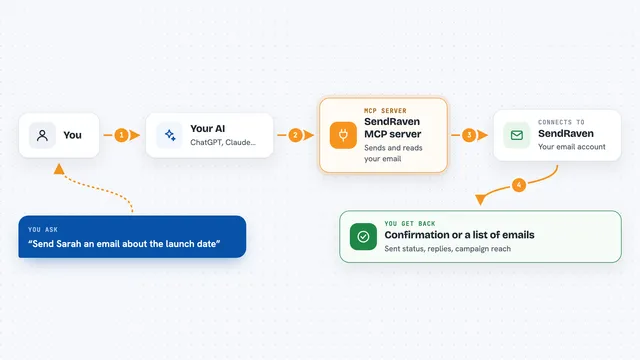
You ask your AI to check its email, send a message, or wait for something to arrive. The AI passes that request to this helper, which talks to your OpenAgentEmail instance over a small web address. The instance reads or sends the mail on your own domain and hands the result back. You then see the answer, the message, or the code right in your chat. It can also keep track of task handoffs between agents, so you can see who asked for what and what came back.
 Click to zoom
What you can do with it
- Send an email from your agent's own address
- Read the messages in your agent's mailbox
- Pull out a one-time code or a verification link from a message
- Wait for a specific email to arrive before moving on
- Hand a task to another agent and read its result
- Record an approval or rejection from a named reviewer
- Check mail, tasks, and notifications in a web dashboard
Try asking your AI
- “Check my agent mailbox and tell me if anything new came in”
- “Send an email to the support address asking for a status update”
- “Wait for the verification email and give me the six digit code”
- “Hand this task to the other agent and let me know when it reports back”
What it gives back to you
You get back plain answers in your chat: a list of new messages, the text of an email, a code or link pulled from a message, or a short note that a task was created or finished. Task handoffs come back with the state history and any result the other agent reported. If a wait times out, you get a simple timeout notice, not an error. Everything stays readable in the conversation.
Before you start
What you need
- An OpenAgentEmail instance, either one you deploy or one run by someone you trust
- Your identity address and identity token from that instance's operator
- Node.js 20 or newer if you use the local helper
- Docker Compose, a domain, and DNS setup if you deploy your own instance
Good to know
Your agent can send mail and change task records on your behalf, so give it a token with only the permissions it needs and keep admin keys out of its setup.
Install it with your AI
Add OpenAgentEmail MCP server to your AI, no technical skills needed
You don't install anything by hand. You copy one prompt, paste it into an AI that can work on your computer, and it checks, installs and connects the server for you, asking you when it needs something.
Sign in to get the install prompt
Members get a ready-made prompt that lets the Claude desktop app check OpenAgentEmail MCP server, install it and connect it for them, step by step. You don't need any technical skills: you copy, paste and answer a few questions. Your connected AI can also find and install any of the 4,609 MCP servers here for you.
Who it's for
People who want their AI to handle email on their own domain, and small teams passing tasks between agents.