MCP server · Security
PCI DSS MCP server
by shyshlakov
Lets your AI check Go payment code for PCI DSS problems and show which rule each one breaks.
This is a helper that looks through Go payment code and points out things that could break PCI DSS rules, like card numbers showing up in logs or weak encryption. It is made for teams that handle card payments and want an early warning before code ships. You do not need to be a security expert to use it, you just ask your AI to run it on a folder.
What is an MCP server? The 30-second version
On its own, your AI can only chat with you. An MCP server is a small helper program that gives your AI a new skill or a connection to another tool. This one connects your AI to a code checker built for Go payment services, so it can read your code and report PCI DSS issues. You ask in plain words, and the helper does the checking behind the scenes.
What this MCP server does
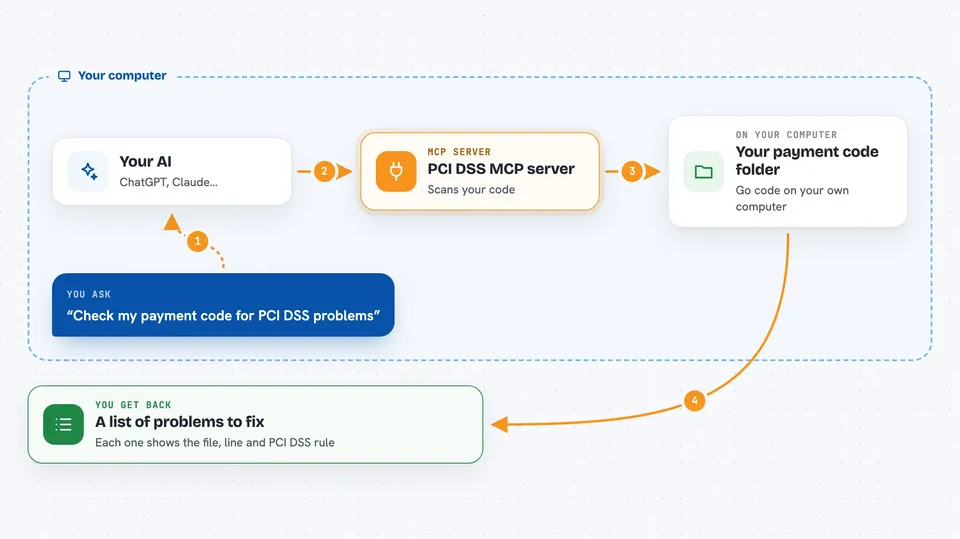
You point your AI at a folder with Go payment code. The AI passes that folder to this helper. The helper runs a set of scanners over the code, looking for things like card data in logs, weak crypto, missing audit logs, and outdated dependencies. Each problem it finds is tied to a specific PCI DSS v4.0.1 requirement number. You get back a list of findings with file and line details, plus a short explanation.
 Click to zoom
What you can do with it
- Find card numbers or CVV values stored or logged in your code
- Spot weak hashing, hardcoded keys, and plain HTTP connections
- Check whether payment actions are written to audit logs
- Look for credentials sitting in config files
- Check your Go dependencies for known vulnerabilities
- Generate a CycloneDX software bill of materials from go.mod
- Look up what a specific PCI DSS requirement says
Try asking your AI
- “Run pci-dss-mcp triage on /Users/you/payments-service and group findings by PCI DSS requirement”
- “Generate a PCI DSS compliance report for /Users/you/payments-service and show pass or fail per requirement”
- “Scan my payment service for card data being written to logs”
- “Check my Go dependencies for known vulnerabilities”
- “Explain PCI DSS requirement 3.3.1”
What it gives back to you
You get a list of findings, each with the file, the line, a severity level, and the PCI DSS requirement it relates to. Some tools give you a pass or fail report per requirement, or a software bill of materials file. Everything shows up in your chat as text you can read and copy. Nothing in your code is changed.
Before you start
What you need
- Go 1.25 or newer if you install it with go install
- Docker if you prefer to run it in a container
- An MCP client like Claude Desktop, Cursor, or Claude Code
- A folder with Go payment service code to check
Good to know
It reads your code to check it, so point it only at folders you are allowed to share with your AI tool, and treat its output as a hint rather than a formal PCI DSS sign off.
Install it with your AI
Add PCI DSS MCP server to your AI, no technical skills needed
You don't install anything by hand. You copy one prompt, paste it into an AI that can work on your computer, and it checks, installs and connects the server for you, asking you when it needs something.
Sign in to get the install prompt
Members get a ready-made prompt that lets the Claude desktop app check PCI DSS MCP server, install it and connect it for them, step by step. You don't need any technical skills: you copy, paste and answer a few questions. Your connected AI can also find and install any of the 4,609 MCP servers here for you.
Who it's for
Go developers and security or compliance folks working on payment services who need a quick PCI DSS check before code ships.