
AI news ·
Academy rules out Oscar nominations for AI acting and writing
The Academy now requires Oscar-eligible acting to be "demonstrably performed by humans" and writing to be "human-authored." AI tools remain allowed elsewhere in production.
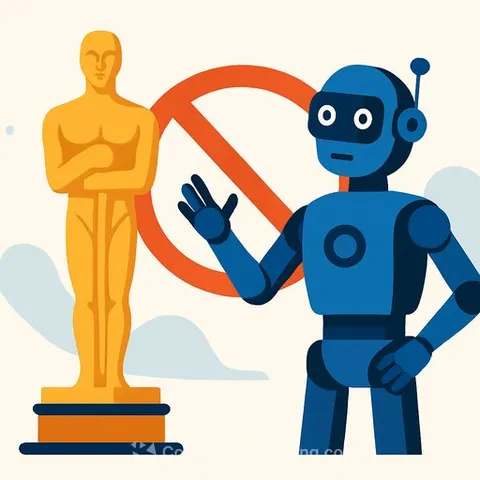
Academy Limits Oscar Eligibility for AI-Generated Writing and Acting
The Academy of Motion Picture Arts and Sciences has restricted Oscar eligibility for two categories: acting must be "demonstrably performed by humans" and writing must be "human-authored." The rules take effect immediately and represent what the Academy called a "substantive" change to its eligibility standards.
The move follows months of high-profile examples where filmmakers used generative AI and LLM tools to replace or recreate human creative work. The Academy's decision narrows the scope of what qualifies as eligible achievement in these two disciplines.
AI use elsewhere remains permitted
The Academy did not ban AI tools from filmmaking broadly. Outside of acting and writing, the use of AI tools "neither help nor harm the chances of achieving a nomination," the Academy said in its updated guidelines.
Filmmakers can use AI in other aspects of production-cinematography, editing, sound design, visual effects-without affecting a film's eligibility. The Academy will evaluate the overall creative merit based on "the degree to which a human was at the heart of the creative authorship."
What this means for writers
For writers in the industry, the rule clarifies that screenplay and story credit requires human authorship. The Academy reserves the right to request documentation about how generative AI was used in the writing process and to verify human involvement in creative decisions.
Hybrid workflows-where writers use AI as a tool but maintain authorial control-remain eligible, provided humans authored the final work submitted for consideration.