
AI news ·
Agentic AI moves lab compound and sample management beyond scripted automation
Agentic AI can reason through lab failures and adapt in real time, handling compound tracking, equipment booking, and full DMTA cycles autonomously. Labs must standardize data and set strict oversight rules before deploying it.
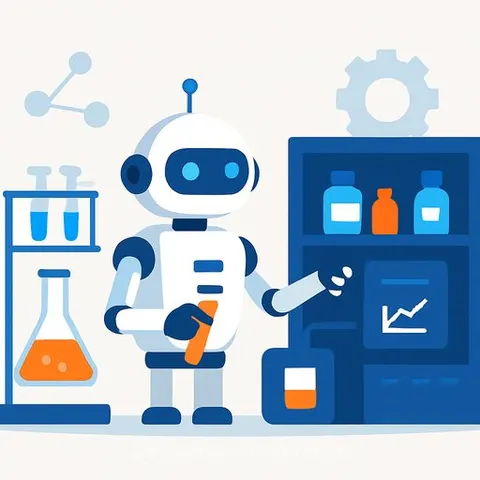
Labs Need AI That Reasons, Not Just Scripts
Laboratory compound and sample management is becoming more complex. Teams now track small molecules, multiple drug modalities, workflows, instruments, solvents, and reagents across integrated systems. Agentic AI-software that reasons and makes decisions autonomously-can handle this at scale.
Most labs already use AI, typically built into existing software or deployed for computational analysis. The next step is different. Agentic AI operates at the intersection of lab hardware and software, bridging the gap between computational predictions and physical experimentation.
Moving Beyond Automation Scripts
Traditional lab automation follows rigid sequences. If one step fails, the entire process stops. Agentic AI analyzes failures and adapts in real time, treating the lab's Design-Make-Test-Analyze (DMTA) cycle as built-in reasoning.
An agent trained on this cycle can:
- Design: Select compounds and doses, propose experiments
- Make: Generate protocols, create plate maps, book equipment
- Test: Monitor runs, capture readings, flag anomalies
- Analyze: Fit curves, score results, suggest next steps
This requires training on actual sample usage patterns across your automated systems so the AI understands how to sequence preparation and experimental workflows efficiently.
Data Connectivity and Standards Matter
APIs and command-line interfaces connect AI to hardware. But AI-to-AI communication is still maturing. Two emerging pathways-model context protocol (MCP) and agent-to-agent (A2A) communications-speed data exchange between lab software platforms like electronic lab notebooks and laboratory information management systems.
Before AI feeds databases directly, those databases must be standardized. They need to handle structured, unstructured, and semi-structured data under consistent schemas aligned with FAIR principles (findable, accessible, interoperable, reusable). Access controls matter as much for AI as for human staff-agents should only read and write relevant entries.
Governance and Human Oversight
In an agentic AI lab, agents propose experiments and handle logistics while scientists review all AI decisions and set overall research direction. This division of labor is not optional-it's essential for compliance.
Audit trails must now document who approved the AI's actions, not just who performed them. Labs also need to guard against unintended consequences. AI might consolidate experiments poorly, consume rare compounds wastefully, repeat past work, or monopolize equipment-unless explicitly constrained.
Agents need input and output validation gates. A dose ceiling prevents an AI from suggesting a two-pound treatment just because it would work biochemically. Confidential projects require additional safeguards so AI doesn't leak proprietary data into broader learning systems.
Industry Standards Are Emerging
ISO/TC 276 addresses biotechnology datasets used to train AI, emphasizing integration and validation. ISO/IEC 5259 sets a framework for data quality in analytics and machine learning. The FDA and other regulators are still catching up to the technology.
What Changes for Lab Managers
Sample management teams own the initial implementation-training agents, setting constraints, coordinating with upstream and downstream research groups. The workload is front-loaded.
Once deployed, the payoff appears immediately. Lab workers spend less time on routine tasks like pipetting and more time on research planning and decision-making. AI agents and automation handle compound prep and inventory via robots running 24/7.
Scientists transition into dual roles: lab manager and researcher, focused on process design and interpreting results rather than execution details. As the AI improves, demand for its services grows, expanding its scope across the organization.
AI for management in lab settings requires rethinking oversight. Managers must understand how agents make decisions, where human review is mandatory, and how to maintain compliance while gaining speed.
Agentic AI in labs is still early. Implementation varies by organization. But the direction is clear: labs that adopt it effectively will operate faster, run longer, and free their best people to focus on science rather than logistics.