
AI news ·
AI ambient scribes gain rapid adoption in healthcare amid accuracy and regulation concerns
Over 60 ambient AI scribe products have emerged, backed by hundreds of millions in investment. Kaiser Permanente's clinicians saved over 15,700 hours in one year using the technology.
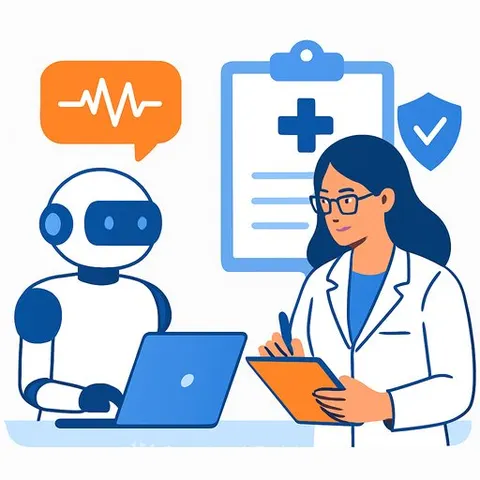
Ambient intelligence, an invisible AI tool that records and transcribes patient visits, is being adopted by clinicians and health systems at a pace the Peterson Health Technology's AI Taskforce calls uncharacteristically fast even without a regulatory mandate. More than 60 competing products have emerged, backed by hundreds of millions of dollars in investment, as the technology promises to reduce documentation overload and clinician burnout.
How ambient intelligence captures patient visits
Ambient AI tools activate when someone speaks, transcribing the entire conversation and turning it into a structured clinical note. At their core, these applications rely on Speech-To-Text technology to capture words and then filter out irrelevant chatter, such as talk about the weather. The notes flow directly into electronic health records, automatically generating prescriptions, lab orders, billing codes, and insurance claims. A few pilot programs can even suggest diagnoses and treatment options when the recorded visit is linked with lab results and in-office vitals.
Fast adoption and heavy investment
Among the dozens of vendors, Abridge, Suki, Ambience Healthcare, DAX Copilot, and DeepScribe have drawn the most attention. Abridge raised $300 million last year, Suki raised $70 million, and San Francisco-based Ambience closed a $243 million round in June. Epic, the widely used EHR vendor, launched its own proprietary ambient charting tool in March after previously partnering with Microsoft's DAX Copilot and Abridge. Other EHR integrations are common, with Ambience connecting directly to Athenahealth, Oracle Cerner, and Epic.
Adoption numbers are mounting quickly. Cleveland Clinic onboarded about 1,000 physicians in eight days after launch, and now 4,000 of 6,000 eligible clinicians use the software, said Eric Boose, MD, associate chief medical information officer. Kaiser Permanente deployed Abridge's technology to over 25,000 clinicians across all its hospitals and medical offices. Mass General Brigham uses ambient AI for more than 2,500 clinicians, while Ochsner Health offers DeepScribe to 4,700 clinicians.
"The idea that you can have software just listen to a normal everyday conversation in our offices and make it into a medical note (is) truly transformative," Boose said. The Peterson task force report stated: "There is no technology in recent memory that has been adopted more enthusiastically by clinicians or has scaled up so uncharacteristically fast, absent a regulatory mandate." That speed, it noted, underscores the importance of AI for Healthcare training for professionals navigating this change.
Reducing burnout and reclaiming time
A JAMA study last fall found the ambient scribes reduced clinician burnout by cutting documentation time. Doctors reported less "pajama time" - the hours spent inputting notes after a day of seeing patients. "Burnout's a multipronged issue and there's no single solution, but we know that clinical documentation is a large contributor to burnout - especially in outpatient arenas," said Jason Misurac, MD, MS, a clinical associate professor with University of Iowa Health Care, in an American Medical Association webinar.
Kaiser Permanente's own research, published in The New England Journal of Medicine in March 2025, found that clinicians using an ambient scribe saved more than 15,700 hours in one year across the medical group, equivalent to 1,794 working days, compared to nonusers.
Beyond scribes: other AI tools testing clinical waters
While ambient scribes dominate, other AI applications are gaining ground. Mass General Brigham implemented CodaMetrix's autonomous medical coding platform, which achieved a 74% automation rate for radiology results and cut claims denials by 58.7%, freeing up 12 full-time coders. UC San Diego Health developed an in-house Clinical Decision Support algorithm called COMPOSE that reduced sepsis-related mortality by 17% in the emergency department, according to a 2024 study. The study found that widespread implementation remains a challenge due to the absence of standardized integration pathways for these technologies.
The unregulated accuracy gap
But the surge in ambient AI brings little oversight. The scribe field operates without regulation, and no independent body monitors accuracy. One recent study warned that scribes can produce errors that will require "vigilance," and the authors said clinicians must review all notes and treat the AI as an assistant, not a replacement. As investment pours in and adoption widens, researchers are calling for standardised quality checks.
Why this matters for healthcare, IT, and research professionals
For clinicians and health system leaders, ambient intelligence can sharply reduce documentation burden if used with careful review. IT and development teams face the challenge of integrating dozens of competing ambient tools with existing EHRs while ensuring data integrity and security. Researchers and policymakers must address the regulatory vacuum: independent studies are needed to validate accuracy, establish safety benchmarks, and guide responsible deployment. The technology's swift uptake makes these tasks urgent.