
AI news ·
AI and social media integration improves creativity and cultural participation in Ecuador secondary schools
A three-month study in Ecuador found that combining AI tools with structured classroom instruction improved creativity, digital skills, and cultural identity among 61 secondary students. Outcomes depended on pedagogy, not technology alone.
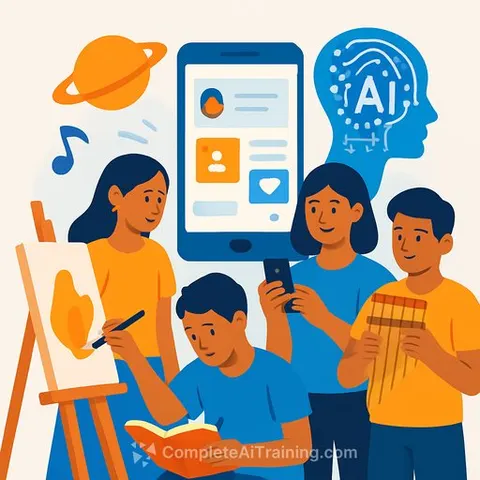
Study Shows AI and Social Media Boost Learning Outcomes in Ecuador Secondary Schools
A three-month educational intervention in northern Ecuador found that integrating artificial intelligence, social media, and digital platforms into secondary education significantly improved students' creativity, digital competencies, and engagement with their own cultural identities.
The research involved 61 secondary school students and 31 university facilitators who participated in a hybrid learning program combining classroom instruction with digital tools, including generative AI and LLM systems for text and image generation. Students worked through three core modules: digital communication, multimedia content creation, and AI-supported professional identity development.
Measurable Gains in Core Competencies
Quantitative results showed statistically significant improvements across digital competencies, creativity, and AI literacy. Students demonstrated increased confidence using digital tools, generating original ideas, and understanding how AI supports learning.
The gains suggest AI functioned as a cognitive scaffold rather than automating tasks. Students used AI to organize ideas, refine outputs, and engage in reflective thinking. However, the improvement depended on how technology was integrated-structured, student-centered pedagogies produced stronger outcomes than unfocused technology use.
Students Used Digital Tools for Cultural Expression
Qualitative findings revealed a shift from passive consumption to active cultural production. Students incorporated local traditions, cultural symbols, and social issues into their digital creations, strengthening their sense of belonging and community participation.
This outcome challenges the assumption that AI is culturally neutral. When integrated thoughtfully, the research shows, AI can support culturally responsive teaching that enables students to produce locally meaningful content rather than reinforcing homogenized digital cultures.
Critical Thinking About AI Emerged Naturally
Students did not treat AI outputs as authoritative. They learned to question results, verify information, and recognize the limitations of algorithmic systems. This reflects what researchers describe as critical AI literacy-a competency combining technical skills with ethical reasoning and reflective judgment.
Teachers and facilitators shaped how students engaged with AI tools, ensuring technology served exploration rather than passive consumption. Students who developed greater confidence in their digital skills were more willing to experiment and take creative risks.
The Hybrid Model Changed Student Roles
The combination of face-to-face instruction and asynchronous digital engagement enabled students to shift from passive information recipients to active participants in knowledge creation. University facilitators introduced new perspectives and fostered more interactive learning environments.
Students reported that this collaborative approach made learning more engaging and relevant. The findings suggest technology alone does not drive change-pedagogy, context, and student agency determine outcomes.
Research Limitations Acknowledged
The study had a small sample size limited to one institution, with no control group to isolate the intervention's effects. The three-month duration was insufficient to assess long-term sustainability of improvements. External factors such as general learning progression and increased familiarity with digital tools may also have influenced results.
Researchers called for larger studies using longitudinal designs and comparative approaches to validate and extend the findings.
For educators interested in AI for Education, the research provides evidence that structured integration of AI tools can support both cognitive development and cultural engagement when paired with strong pedagogical design.