
AI news ·
AI automation shrinks entry-level job postings, pushing universities to fill the experience gap
Entry-level job postings have dropped 35% since 2023, cutting off the traditional path where new graduates built workplace skills. Schools must now fill that gap before students hit a job market with no room to learn on the job.
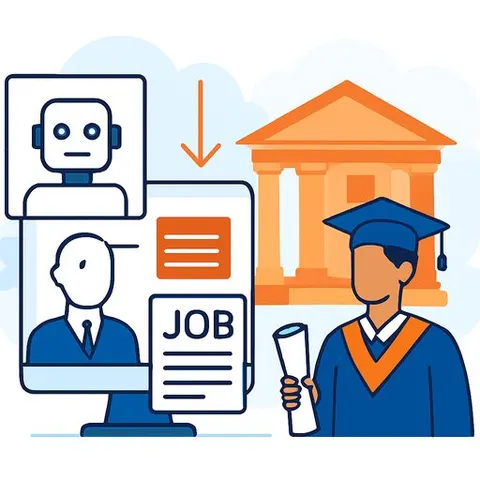
Entry-Level Job Postings Drop 35% as AI Automates Early-Career Tasks
Entry-level job postings have declined 35% since 2023, eliminating the traditional pathway where new graduates learned workplace skills. The disappearance of these roles creates a practical problem: employers no longer have a business case for training early-career workers when AI can handle those tasks instead.
For decades, entry-level positions served a specific purpose beyond filling immediate staffing needs. They taught new workers how to operate in a professional environment, build foundational skills, and gain confidence before taking on more complex work. That apprenticeship model assumed employers would continue investing in early talent development. That assumption no longer holds.
Educational Institutions Must Lead, Not Follow
The traditional split between employer and school responsibilities is breaking down. Schools can no longer rely on entry-level roles to provide the experience their graduates need. Educational institutions must now take the lead in designing programs that replicate the first one to two years of professional work.
This shift doesn't mean employers step away entirely. But it does mean schools need to redesign what happens in the classroom to better match what happens in the workplace.
Embed Real-World Application Into Coursework
The most direct approach is to stop treating learning and application as separate activities. Schools can now use simulation tools, virtual reality, and augmented reality to let students practice in realistic job settings-whether that's a technical trade or a professional services role.
When students apply concepts as they learn them, they graduate with practical skills, not just theoretical knowledge. The classroom becomes a working environment rather than a preparation ground.
Build a Pipeline Through Work-Integrated Learning
Internships have become harder to secure. More than half of students seeking internships cannot find one, and applications are nearly twice as competitive as they were a year ago. Schools can address this gap by running structured co-op and work-integrated learning programs that let students alternate between classroom work and real employment throughout their education.
This approach gives students the career-aligned skills that often matter more than a degree alone. It also creates a steady supply of experienced early-career workers for employers, replacing what entry-level roles used to provide.
For educators, the challenge is clear: redesign programs around real-world application, or watch graduates enter a job market that no longer has room for them to learn on the job. Learn more about how AI for Education can support this shift, and explore resources for teachers implementing these changes.