
AI news ·
AI begins to outperform human chip designers in narrow tasks but still needs significant human guidance, Berkeley researchers say
AI is outperforming human engineers on specific chip design tasks. Google DeepMind's AlphaChip beat human layouts on three TPU generations; Synopsys logged 100+ production tape-outs with 3x productivity gains.
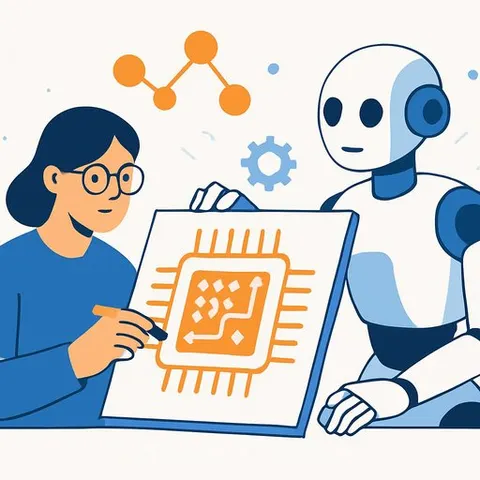
AI is starting to outperform chip engineers in narrow design tasks
Artificial intelligence systems are beginning to produce better chip designs than human engineers in specific, well-defined areas of the design process. Google DeepMind's AlphaChip has generated layouts for three generations of the company's Tensor Processing Units that DeepMind claims exceed human-designed alternatives. Synopsys has completed over 100 production tape-outs using its DSO.ai tool, reporting productivity gains exceeding three times and power reductions up to 25% for customers including STMicroelectronics and SK Hynix.
The shift reflects how AI is being applied differently across the industry. Companies like Google and Synopsys focus on automating existing processes to reduce costs and improve efficiency. Researchers at academic institutions are pursuing a separate path: using AI to discover designs humans haven't yet conceived.
Where AI delivers measurable gains
The wins are coming in specific corners of chip design, not across the entire workflow. Low-level tasks show the clearest benefits. Power and ground networks - the metal webs that distribute electricity across a chip - were previously designed using informal natural language descriptions that engineers had to manually convert into formal specifications. AI can now handle this translation in hours instead of days.
High-level orchestration of design flows offers another opportunity. AI can decide whether a design run is salvageable or needs to restart entirely, a decision that compounds in value when a design is already performing reasonably well. "If you take a zero multiplied by something, you get a zero," said Igor Markov, a chip design researcher who has spent years in electronic design automation. "But if you already have something decent, then this high-level control can be very, very enabling."
Analog design, long considered the final stronghold of human craft in chip engineering, is beginning to yield to AI. Researchers have developed systems like AnalogGenie, which uses a language model approach to discover new circuit topologies, and Princeton's AI-enabled system for designing millimeter-wave and sub-terahertz power amplifiers.
The role of human guidance remains critical
AI systems excel where humans tend to get stuck: they don't carry the assumption that an old design topology must be close to optimal when porting to a new process node. This absence of ingrained patterns becomes an advantage.
However, humans remain essential. Researchers at UC Berkeley working on cache replacement policies found that AI generates genuinely new logic, but only with substantial human direction. "There is still a lot of human guidance, and it kind of up-levels the kind of thinking humans have to do," said Sagar Karandikar, a computer architecture researcher at Berkeley. "The humans involved in that project are doing more of the high-level thinking - coming up with new ideas and guiding the LLM - and the LLM does a lot of the finer policy development around that."
Their ArchAgent system, built on Google DeepMind's AlphaEvolve framework, produced a cache replacement policy in two days that improved performance by 5.3% on Google's multi-core workload traces. On single-core benchmarks, it took 18 days to achieve a 0.9% improvement - demonstrating that AI can optimize designs beyond what humans have previously achieved, but not instantly or without careful guidance.
Testing in theory versus practice reveals limits
AI systems can perform well in controlled demonstrations but struggle with the messier problems engineers face in production. "Whether something that works in five cases works in general, and allows you to innovate, that's the key," Markov said.
Specification itself becomes a problem. Ask an AI model to design the best chip for AI applications without defining precisely what "best" means, and it will produce something - but likely not what you need. "You will play whack-a-mole," Markov said, describing the iterative frustration of fixing one issue only to create another.
AI as force multiplier, not replacement
For now, AI functions as a force multiplier. Teams aren't shrinking; instead, they're producing more output. The composition of those teams is shifting, though. Engineers fluent with AI coding assistants are now in demand in ways they weren't six months ago.
History suggests this pattern will continue. Shortest-path algorithms for wire routing, once seen as distinctly human work, became undergraduate material. Placement algorithms now routinely outperform human designers. Logic synthesis, once considered too abstract to automate, is handled by standard programming constructs. "EDA has always been a type of AI, because it automated what people did," Markov said. "We are just moving along the straight line, and there's no stopping."
As AI makes certain design tasks faster and cheaper, engineers will likely redirect that freed capacity toward problems they previously avoided. That includes designing the AI accelerators driving the current cycle - arguably the most structured, performance-critical silicon available for optimization.
Learn more about Generative AI and LLM applications in specialized domains, or explore the AI Learning Path for Software Engineers to understand how these tools are reshaping engineering workflows.