
AI news ·
AI doesn't just enable bad writing, it crowds out the good
AI is flattening writing by removing mistakes alongside originality, producing grammatically perfect but predictable prose. The deeper risk: when machines write for us, we may lose the ability to think independently.
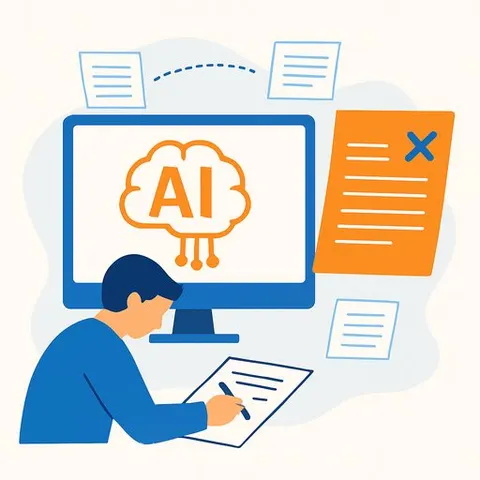
AI Is Flattening Good Writing Along With the Bad
Roald Dahl predicted this in 1953. His short story "The Great Automatic Grammatizator" featured a machine that could produce a five-thousand-word story in thirty seconds. The protagonist offered famous writers a deal: accept payment for life, stop writing, and let the machine publish under their names. Most accepted. Literature survived. Writers did not.
Seventy years later, the prophecy is unfolding. The machine is now called artificial intelligence.
The Paradox: Better Grammar, Worse Writing
AI has not democratized writing. It has industrialized mediocrity. Everyone can now produce grammatically flawless prose. Spelling errors vanish. Punctuation aligns. But so does anything fresh, original, or provocative.
The result feels eerie. Articles read similarly. Mistakes disappear alongside surprises. Sentences are correct but predictable. Language is polished but drab.
Great writing emerges from struggle. It comes from risk, failed attempts, and strange sentence structures that eventually become beautiful. When writers stop wrestling with language because a machine offers perfect phrases instantly, how will they find their own voice? If someone never writes badly, how will they recognize good writing?
Why AI Defaults to Safety
AI thrives on patterns. It predicts what comes next based on what came before. This makes it efficient and inherently conservative.
Real writing breaks rules for beauty. It invents words when existing ones fail. It bends language to reveal something new. It belongs to people who thrive in gray areas.
AI prefers safety. It smooths edges, removes discomfort, flattens language. Combined with growing pressure toward political correctness, writing becomes sterile and emotionally hollow.
There is also the problem of authenticity. Readers increasingly wonder: whose voice is this-the author's or the machine's? That uncertainty erodes trust in what they are reading.
The Deeper Cost: Loss of Thinking Itself
The threat extends beyond aesthetics. Writing is how humans discover what they think. Multiple drafts are part of the discovery process. When machines do the work, that process collapses.
There is also a psychological cost. Many people derive self-worth from writing work. What happens when machines eliminate those jobs? Even if universal income becomes reality, the loss of meaningful work carries a price.
The most dangerous outcome is cognitive. Just as self-parking cars make drivers forget how to parallel park, AI may slowly erode the human ability to write-and to think independently. Young people already struggle with long-form handwriting because they rarely use pen and paper. AI threatens to extend this decline into mental writing.
A civilization that cannot write will eventually lose the ability to think independently.
The Adversary Arrived as a Friend
AI did not announce itself as a threat. It arrived promising comfort, speed, efficiency, ease. It offers help, not destruction. That is precisely what makes it dangerous.
The threat does not ask people to stop writing. It encourages them to stop trying.
A larger crisis lurks beneath: the death of serious reading. When tweets pass for literature and publishers chase viral social media followings instead of intellectual depth, the appetite for serious reading shrinks. When popularity replaces substance, literature becomes performance rather than pursuit.
Without good readers, good writers cannot emerge.
The Path Forward
This is not an argument against technology. It is an argument against surrender.
Use AI as a tool if necessary. But never let it become your voice. Write badly. Write slowly. Write painfully. Rewrite if needed. Literature was never supposed to be smooth and easy. It was supposed to be bumpy, argumentative, deliberative-and human.
Understanding how generative AI and large language models work can help writers recognize what the technology does well and where it falls short. That knowledge becomes a tool for resistance.
Dahl saw this coming decades ago. If we lose writing, we lose more than books. We lose thinking itself.