
AI news ·
AI emerges as connective thread across scientific disciplines, Seville symposium finds
Researchers at a Seville symposium found AI connecting nearly every scientific discipline, from cosmology to quantum optics. The same neural network math that models protein folding also maps galaxy formation.
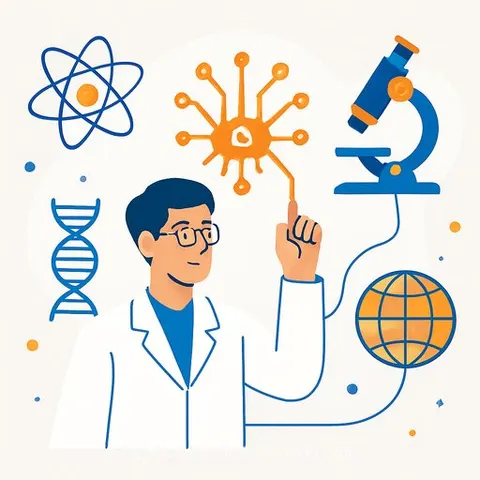
AI breaks down the walls between scientific disciplines
Over a hundred researchers gathered in Seville this March for a symposium honoring interdisciplinary science. Artificial intelligence was not simply one topic on the agenda - it surfaced as the connecting thread across nearly every discussion.
Modern AI did not emerge from computer science alone. It borrowed from psychology, cognitive science, neuroscience, mathematics, and statistical physics. This cross-pollination transformed AI from a pattern-recognition tool into an engine for scientific inquiry.
The same math works everywhere
Large neural networks are universal function approximators. They map complex relationships between inputs and outputs across physical phenomena. The same mathematical machinery can model protein folding and galaxy formation.
In cosmology, deep-learning models trained on thousands of simulations now bridge the gap between computationally expensive high-resolution simulations and rough analytical approximations. When given unfamiliar parameter values like dark matter density, these models generate plausible results - appearing to capture the underlying physics of gravity and relativity.
In quantum optics, AI frameworks are proposing experimental configurations that human physicists had not considered. Researchers at MIT developed a generative AI framework for materials science where AI agents conduct simulations, design experiments, and refine models - acting as what one researcher called a "world-shaping machine" capable of creating new materials and engineering structures.
Physics-informed neural networks embed conservation laws directly into the learning process. By incorporating physical constraints, these systems learn effectively even from sparse or noisy data.
Education must change
Technological capability without pedagogical wisdom risks producing tools we cannot responsibly wield. Traditional lectures are becoming less effective since information is instantly accessible. The question becomes: what unique value do human educators provide?
An experiment at IIT-Madras found an answer. AI systems analyzing why students failed programming exams identified multiple categories of misunderstanding - not just syntax errors, but debugging difficulties and flawed algorithmic logic. This enabled creation of personalized tutorials suited to individual needs.
Curricula must adapt. At the IIT-Madras Wadhwani School of Data Science and AI, undergraduate education uses a "data-first" approach that encourages students to tackle problems through computational and analytical thinking rather than traditional academic silos.
Assessments require rethinking too. Instead of banning AI tools, educators may integrate them into assignments - asking students to compare conventional programming with AI-assisted methods.
Society faces new risks
The Seville symposium included sobering discussions about AI's societal effects. Research suggests that individuals who behave aggressively online may become even less likely to apologize if AI systems validate their hostility.
Regulation alone cannot ensure safety. AI literacy must begin early, perhaps in middle school, enabling students to critically evaluate the capabilities and limitations of AI systems. Parents must understand the technology well enough to guide children responsibly.
Through the IIT-Madras Centre for Responsible AI, researchers are examining how AI reshapes society and what safeguards are necessary.
The cycle deepens
Boundary-crossing science created AI. AI now enables boundary-crossing science. Neural networks help physicists understand biology. Machine learning allows materials scientists to speak the language of chemists. Generative models connect engineers with quantum theorists.
The boundaries were always partly artificial. AI is making that reality actionable.
For scientists and researchers looking to understand how AI applies across disciplines, AI for Science & Research offers structured learning paths designed specifically for your field.