
AI news ·
AI exposes education's longstanding confusion between outputs and understanding
AI can now write essays and generate working code, exposing a deeper problem: education has long measured outputs instead of understanding. The real fix isn't blocking the tools-it's rebuilding how learning is assessed.
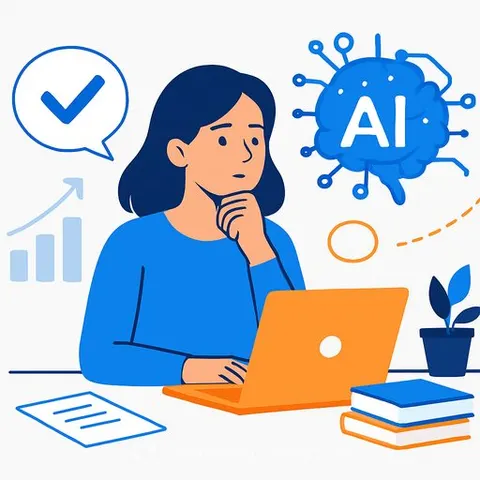
AI Isn't Killing Education. It's Exposing What We've Been Measuring Wrong.
Higher education faces a reckoning, but not the one most people think. AI systems can now write essays, solve problem sets, and summarize entire fields of study in minutes. The panic is predictable: concerns about plagiarism, assessment integrity, and declining student effort.
The real issue runs deeper. AI doesn't threaten education-it exposes where institutions have substituted measurable outputs for actual learning.
The Difference Between Output and Understanding
Higher education was never primarily about producing answers or job-ready skills. It was about cultivating judgment: how to reason, justify claims, recognize the limits of knowledge, and decide what can be trusted.
Consider programming. AI can generate moderately complex code easily. But writing code that works is not the same as understanding why it works, under what assumptions it's valid, or how it might fail. A program without clearly specified preconditions, postconditions, and invariants isn't just incomplete-it's untrustworthy. AI produces the artifact. Disciplined reasoning produces certainty.
The same principle applies across disciplines. A student can produce an essay on historical causes, but can they evaluate competing explanations and defend their interpretation? A model can claim 95 percent accuracy, but does the student understand what that number means or whether it matters in context?
These aren't narrow skills. They're habits of mind-forms of intellectual discipline that cannot be outsourced.
Why Assessment Is Actually Broken
AI systems excel at producing the artifacts we've come to treat as evidence of understanding. They generate coherent essays, working code, and sophisticated analyses. When outputs become cheap and abundant, they stop being reliable indicators of learning.
This is why the current assessment crisis is so often misdiagnosed. The problem isn't that students can cheat more easily. It's that assessment methods have depended on outputs that can now be generated without corresponding understanding. Take-home assignments, essays without personal interaction, and coding exercises were always imperfect measures. AI has simply made their limitations impossible to ignore.
The Same Problem in Research
AI tools can summarize literature and generate plausible syntheses. They can also produce incorrect claims, fabricate citations, and present shallow conclusions with fluency. The challenge isn't academic misconduct-it's epistemic trust. If institutions cannot reliably distinguish between well-founded knowledge and plausible-sounding fabrication, scholarly integrity is at stake.
What Changes Now
The response requires rethinking education itself, not fighting the technology.
- Shift from outputs to reasoning. Ask for justification, not just answers. Oral examinations, iterative problem-solving, and open-ended discussions that probe understanding become essential.
- Train students to verify. They should question claims, interrogate metrics, and identify assumptions. In an environment where information is abundant but unreliable, the ability to decide what to trust is foundational.
- Value uncertainty as a sign of maturity. A student who says, "This argument holds under these assumptions, but I'm unsure whether they apply," demonstrates deeper understanding than one confidently presenting a machine-generated answer.
- Align AI adoption with educational purpose. Introducing AI assistants without rethinking pedagogy and evaluation risks reinforcing the proxies that are now failing.
The Real Competition
Universities face pressure from online platforms offering modular skills and certifications. That's not actually competition-platforms excel at what they're designed for. Universities, at their best, do something else: form judgment.
The real danger is internal drift-treating education as a sequence of tasks to complete rather than a process of intellectual development.
AI, in this sense, is a diagnostic tool. It reveals where institutions have substituted measurable outputs for meaningful learning, and where they've mistaken fluency for understanding.
In a world where answers are cheap, judgment becomes scarce. Higher education must decide whether it produces the former or cultivates the latter. For educators implementing these changes, resources on AI for Education and AI Research Courses can provide practical frameworks for assessment redesign and knowledge verification in an AI-enabled environment.