
AI news ·
AI exposes longstanding gaps in medical education that physicians created long before the technology arrived
AI is already in medical education - in residents' pockets, in patient hands, embedded in health systems. The deeper problem is a training system that no longer fully delivers what it was built to produce.
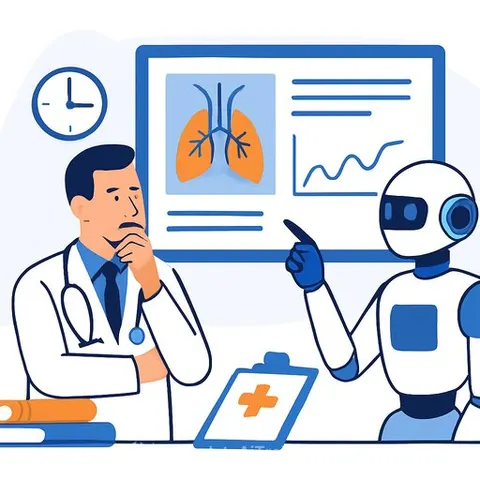
AI Is Already in Medical Education. The Real Problem Is Older Than That
Every few years, the medical profession declares that the next disruption will either save or destroy how physicians train. Duty hour restrictions. Pass/fail licensing exams. Virtual care. Now it's AI.
The question being asked is wrong.
AI isn't coming to medical education. It's already there-in residents' pockets on rounds, in patients' hands during appointments, embedded in workflows across major health systems. The real question is whether the profession is honest about what medical education was designed to produce, and whether the current system still does that job.
It doesn't fully. And that's not AI's fault.
The gap between passing and practicing
Large language models now pass the United States Medical Licensing Examination. That's remarkable. It's also mostly irrelevant.
A patient doesn't arrive with a well-formatted clinical vignette and five answer choices. They arrive with decades of life experience, incomplete histories, and communication shaped by everything that happened before they found their way to the exam room.
Early studies show AI performing well on isolated clinical scenarios perform quite differently when a real human with actual communication is in the loop. Accuracy drops significantly. Context is everything, and context comes from years of human interaction-not from optimizing for test performance.
What physicians are trained to do and what they're tested on have drifted apart. AI is exposing that drift in ways worth taking seriously.
Teaching with AI, not without it
Pushing AI out of training would be like training pilots without flight simulators. The goal isn't to eliminate it; it's to teach physicians to use it the way skilled clinicians use any resource: with judgment, skepticism, and a clear sense of its limits.
Attending physicians need to model what responsible AI use looks like. Not avoiding it on rounds, but demonstrating how to stress-test an output, trace a reference to primary literature, and recognize when a tool is hallucinating with confidence. Clinical reasoning hasn't become less important in an AI-enabled world. It's become more important, because someone must decide whether to trust the machine.
A medical student today can use an LLM to simulate patient encounters and run through clinical scenarios thousands of times-reps that previous generations never had. That's not deskilling. It can be an equalizer if built into training intentionally rather than left to chance.
The structural problems AI didn't create
Medical literature doubles roughly every 73 days. Curricula haven't kept pace.
Medical schools still largely select students based on individual academic achievement at a moment when medicine is fundamentally a team sport. Some specialties and geographies are oversupplied while others desperately need primary care providers. Trainees graduate with $300,000 to $400,000 in debt, then the profession expresses surprise when financial pressure shapes their specialty choices and willingness to practice in shortage areas.
AI didn't cause any of that. But it forces the question of whether the return on that investment in time, money, and years of a physician's life is being maximized by a system designed in a different era.
What comes next
A reimagined medical education system would select for the qualities that make great physicians: empathy, curiosity, resilience, and the ability to function on a team-not just the ability to survive standardized metrics.
It would integrate AI as a teaching tool from day one, with faculty modeling how to use it responsibly rather than pretending it doesn't exist. It would emphasize microlearning, case-based reasoning, and contextual, human-centered problem-solving that no model has figured out how to replicate.
The physicians who will thrive aren't the ones who memorized the most. They're the ones who know how to learn continuously, use tools critically, and do something AI cannot: walk into a room, read a face, and make a person feel seen.
The technology will change. The mission doesn't.
Learn more: Explore how AI for Education is reshaping learning environments, and understand AI for Healthcare applications in clinical practice.