
AI news ·
AI exposes that education was never primarily about information
AI can generate summaries, but it cannot develop judgment. The danger is that students may conclude their own thinking no longer matters.
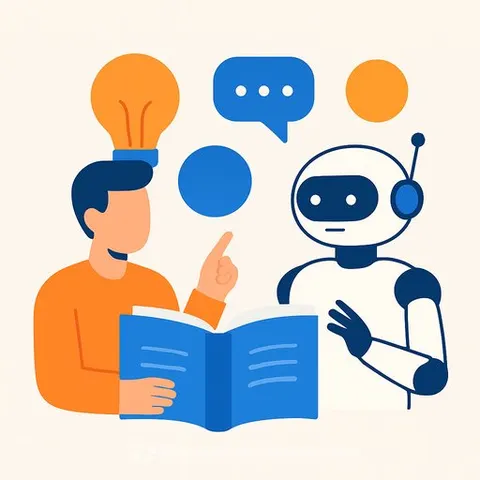
A cultural message circulating among young people holds that "Artificial intelligence will soon do everything you do, and it will do it faster and better than you ever could." For teenagers, the idea that their own effort may soon be irrelevant is not just unsettling - it is existential. Schools are now being forced to confront a question that goes far beyond cheating or screen time: what is education actually for now?
In classrooms, the friction that once defined learning has largely disappeared. A 15-year-old with a school-issued Chromebook can summon an answer to any question in seconds. Why wrestle with an essay when a machine can draft one instantly? Why commit a fact to memory when retrieval costs nothing? When thinking feels inefficient, students absorb a subtle but corrosive lesson - that their own minds are already obsolete.
For most of modern history, education was built on the assumption that information was scarce and teachers were its gatekeepers. That model no longer holds. Information is now overwhelming, not rare, and the old justification for schooling rings hollow to students who live online. Yet the disruption may surface a truth that was always there: education is not primarily about transmitting information. It is about forming people.
A purpose beyond answers
As the analysis notes, "Education, at its best, is not about producing answers. It is about forming people." AI can generate summaries, but it cannot develop judgment. It can imitate creative work, but it does not experience wonder, frustration, or moral responsibility. Discernment, curiosity, resilience, and empathy - the capacities that make someone capable of living well with others - are the real work of schooling.
The risk is not that students will use AI. "The danger is that they may conclude their own thinking no longer matters." When young people absorb a cultural message that machines will outperform them in everything, motivation corrodes. The hard work of learning - the misunderstanding, the failed attempt, the slow correction - gets traded for the appearance of competence. That appearance, though, is hollow. AI offers answers without the formative journey that makes knowledge personal.
Struggle is the mechanism
Learning scientists have long shown that difficulty deepens understanding, and that time away from screens fuels curiosity and creative insight. Remove effort entirely, and learning becomes shallow mimicry. The paradox for educators is sharp: the same tools that can tutor a student through a difficult concept can also be used to bypass the thinking that makes the concept stick.
What changes in an age of AI is not the core of education but the questions we ask of it. Critical thinking becomes less about fact recall and more about evaluating truth. Writing becomes less about producing tidy text and more about clarifying thought. Creativity shifts from novelty of output to authenticity of perspective. In this sense, AI could force education back toward its oldest philosophical roots - the cultivation of wisdom through questioning and dialogue, not the mere delivery of content.
Educators navigating this shift are finding that resources like an AI Learning Path for Teachers can help them integrate tools without sidelining student effort. The goal is to use AI in ways that strengthen, rather than short-circuit, the hard work of developing a mind.
A quiet affirmation of human dignity
There is a dimension here rarely acknowledged in policy discussions. Human worth has long been tied to the capacity to think and create. If students begin to believe they are inferior to machines, they may internalise a diminished sense of their own value. Education must therefore affirm something countercultural: a student's worth is not measured by speed, productivity, or optimisation. It lies in consciousness, relationship, moral agency, and the capacity to love and be loved - qualities no algorithm possesses.
Why this matters for Education professionals
The bored teenager staring at a Chromebook already knows AI is powerful. What they need is a reason to believe their own mind is still worth developing. For teachers, school leaders, and learning designers, the task is now explicit: articulate that reason convincingly, and build classroom practices that let students experience the value of their own thinking. An AI for Education approach that foregrounds formation over efficiency will be essential. In a time when machines can produce answers instantly, education's purpose comes into sharper focus than ever - not to compete with artificial intelligence, but to nurture the deeply human intelligence that gives knowledge meaning.