
AI news ·
AI-generated summaries risk eroding critical thinking in higher education, researcher warns
AI summaries are replacing the messy, critical work of research - and students often can't tell what's been left out. Universities need to teach AI literacy, not just AI skills.
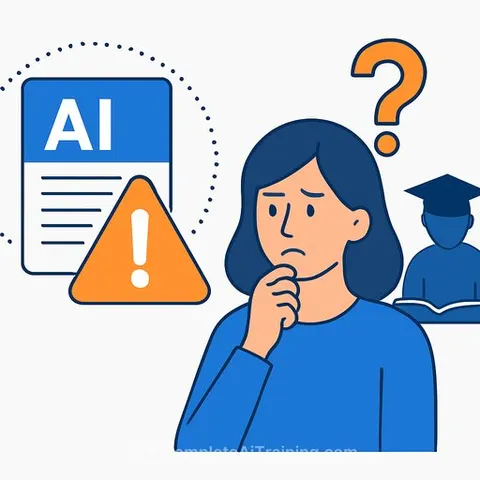
AI summaries are quietly reshaping how students research - and what they learn
Universities face a problem that looks efficient on the surface but undermines the core work of higher education: AI-generated summaries are replacing the messy, critical process of research itself.
Students once learned to search by evaluating sources, comparing perspectives and weighing competing claims. Search engines were imperfect but they forced intellectual work. Now platforms like Google and ChatGPT deliver single, confident answers. The friction is gone. So is the thinking.
The issue is not that AI gets things wrong. It is that it gets things selectively right.
The bias hiding inside authoritative answers
AI systems train on vast amounts of scraped content - Wikipedia, Reddit, YouTube, online reviews. These sources are uneven, opinionated and shaped by user participation rather than expertise. When synthesized into a single response, they produce something subtler than misinformation: a filtered view that appears neutral.
A student reads an answer that sounds authoritative. They do not see that certain perspectives have been quietly privileged over others. Some researchers call this the "white noise" of misinformation - the student is not misled by outright falsehood but guided by emphasis.
This dynamic becomes more powerful when AI surfaces what stands out. Imagine a student researching a university, a policy issue or a scientific debate. Among thousands of consistent data points sits one outlier: a striking claim, a highly negative review, an unusual interpretation. Traditional search engines might bury it. AI systems, designed to identify patterns, often elevate it - precisely because it is unusual. One marginal perspective can be presented as representative, shaping the entire research project from the start.
Economics are shifting the information landscape
Search engines already operated under commercial pressure. That logic is now moving into AI responses. As advertising becomes embedded in these systems, the boundary between information and promotion blurs. For students, this raises a direct question: the most persuasive answer might not be the most accurate but the most optimised.
The real risk is cognitive, not just about writing
Much anxiety about AI in education focuses on writing skills. But the deeper concern is thinking itself. If students rely on AI summaries as starting points, they bypass the intellectual work that defines critical thinking: weighing competing claims, identifying gaps and grappling with uncertainty.
AI is also designed to optimise user experience, which means these systems often reflect back what users already believe. In disciplines built on contestation and critique, this is a fundamental problem. It narrows the range of perspectives students encounter and contradicts how learning actually happens.
What universities should do now
Banning AI would be shortsighted. Students need to know how to use it, and it is already embedded in research. Teaching better prompts is not enough either - that treats a human problem as a technical one.
Instead, universities must make AI an object of critical study.
- Make the system visible. Students need to understand what data AI draws from, how it prioritises information and why certain outputs appear authoritative. Understanding what is inside the "black box" should be part of the curriculum.
- Build AI literacy, not just AI skills. Using AI effectively differs from understanding it. Students should interrogate outputs: What perspectives are missing? What sources are being privileged? How might an answer change with different framing? Assignments should reward questioning answers as well as providing them. Prompt engineering is only one piece of this work.
- Confront preference as bias. Bias in AI is often discussed in extreme terms, but its most common form is preference - what a user likes shapes what the system returns. Students risk mistaking personalised outputs for objective truth. Bias awareness requires self-reflection: What are my preferences? How would someone on the opposing side view these answers? How is AI framing this to satisfy my preconceived views?
Higher education exists to deliver answers but also to cultivate the capacity to question them. The more seamless AI responses become, the easier they are to accept without question. And the further that goes, the closer we move toward forgetting how to think without it.
Educators can start by exploring AI for teachers resources that address how to integrate critical AI analysis into curriculum design and teaching practice.