
AI news ·
USC receives $200-million gift from trustee Mark Stevens to expand AI across campus
USC received a $200 million donation from venture capitalist Mark Stevens to expand AI across the university. The gift renames its School of Advanced Computing and will fund faculty hires in medicine, cybersecurity, business, and the arts.
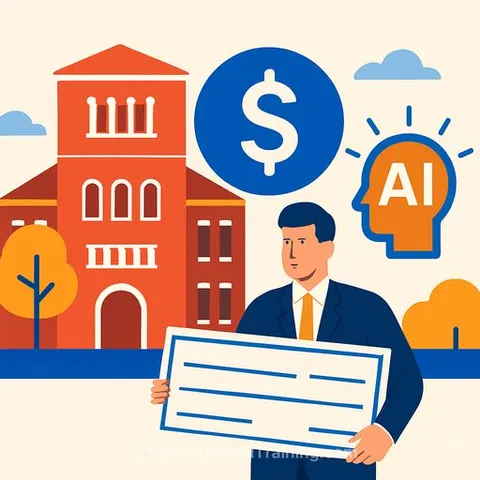
USC Receives $200 Million AI Gift, Largest Donation in University History
USC announced a $200 million donation from venture capitalist Mark Stevens and his wife, Mary, to expand artificial intelligence across the university. The gift will rename the School of Advanced Computing to the USC Mark and Mary Stevens School of Computing and Artificial Intelligence and fund faculty recruitment in AI-related fields.
The donation marks one of the largest in USC's history and comes as major universities compete for AI talent and resources. USC President Beong-Soo Kim, appointed in February, said the timing is critical as AI moves from research labs into nearly every sector of society.
Part of Broader University Investment Surge
The gift follows a wave of nine-figure AI donations to major universities. In April, the Michael and Susan Dell Foundation gave $750 million to the University of Texas at Austin for AI initiatives in health. Last month, the University of Wisconsin-Madison received $100 million for a new College of Computing and Artificial Intelligence.
Hiring Across Multiple Disciplines
USC plans to recruit researchers and faculty beyond those focused solely on AI development. The university will hire scholars who can apply AI to medicine, cybersecurity, national security, business, entertainment, and other fields.
Kim said the intersection of AI with USC's existing strengths - in medicine, engineering, business, and the arts - positions the university to compete nationally. In health sciences, he pointed to ongoing research in regenerative medicine, neuroimaging, and Alzheimer's disease, where AI is helping scientists understand disease at the cellular level.
The university is also positioning AI as a creative tool. The School of Cinematic Arts has begun integrating the technology into music, dance, and dramatic arts, though Kim emphasized the focus is not replacing human creativity.
Faculty Express Concerns About Implementation
Some USC faculty say the expansion requires careful planning. Sanjay Madhav, an associate professor of technology and applied computing practice, said students increasingly use tools like ChatGPT to avoid critical thinking.
"In my classes, students are increasingly using tools like ChatGPT to offload their critical thinking skills," Madhav said. "I honestly am unsure how to best continue to educate my students in a world where these AI tools exist."
Madhav argued that AI policies should not apply uniformly across campus. Faculty need flexibility to set rules for their specific disciplines and courses, he said.
A USC AI committee is developing recommendations for classroom use, curriculum, academic integrity, and ethics. The university is considering AI courses and resources for students in every major, along with coursework on AI's societal impact and ethics.
Stevens' Long History Supporting USC
Stevens, 66, is a managing partner at S-Cubed Capital and former partner at Sequoia Capital. His net worth exceeds $11 billion, much of it from his stake in chipmaker Nvidia, where he sits on the board.
This donation builds on Stevens' previous support for USC. In 2004, he gave $22 million to establish the USC Stevens Center for Innovation. In 2015, he donated $50 million for the USC Mark and Mary Stevens Neuroimaging and Informatics Institute.
Stevens said universities risk falling behind if they do not invest quickly in AI, especially as private companies have produced major recent breakthroughs rather than academic labs.
He also acknowledged risks. "AI in the wrong hands can be very destructive," Stevens said. He called on universities to establish safeguards and understand the ethical implications as AI spreads.
Broader Questions About AI in Education
Universities are responding to AI in two ways: giving students access to tools like ChatGPT, and investing in AI research across fields. Amy Eguchi, a teaching professor at UC San Diego who studies AI, said the USC donation reflects the second approach.
But campuses struggle with what AI means for teaching and learning. Eguchi said the core challenge is determining what students need to learn about AI when the technology is changing rapidly.
"Universities teach students to ask what does it mean to be human, right? But AI is complicating that question," Eguchi said.
Kim acknowledged concerns about AI's potential to undermine human judgment and creativity. He said USC aims not only to lead in using AI but to be "the most thoughtful university in terms of how to use AI in an ethical and responsible way."
For educators managing these tensions, understanding both the AI for Education opportunities and challenges is essential. The broader applications of Generative AI and LLM technology across disciplines underscore why institutional guidance matters.