
AI news ·
AI reduces ticket volume but leaves support agents with harder, more draining work, raising attrition risk
AI is making support jobs harder by filtering out routine tickets and leaving agents with only complex, emotionally draining cases. Companies still measuring success by ticket volume are missing rising burnout and a growing attrition risk.
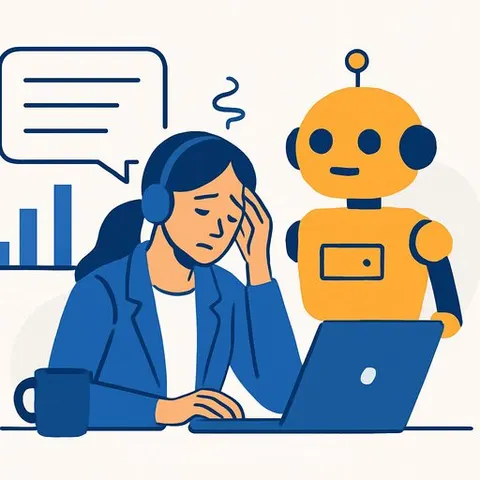
AI Is Making Support Jobs Harder, Not Easier
Customer support teams face a hidden attrition risk as AI removes routine work but leaves agents with more complex, emotionally demanding cases. Companies that measure AI success only by ticket reduction miss the real problem: the remaining work can drain employees faster than high volume ever did.
When AI handles basic requests, human agents inherit conversations that require judgment, empathy, and real-time decision-making. A customer with a complex issue or complaint now reaches a person who must balance company policy with customer satisfaction-often without a clear playbook to follow.
That pressure matters. According to Accenture research, 87% of customers will avoid a company after one bad service experience. The cases AI cannot handle are often the interactions that decide whether a customer stays or leaves.
The Three Talent Problems Companies Overlook
1. Measuring success by ticket volume alone. Lower ticket counts can mask rising burnout. If agents spend their day handling only difficult, emotionally taxing cases, the reduced workload provides no relief. "The volume has reduced and maybe you're not working overtime hours," says Funmi Mide-Ajala, Director of Customer Support and Digital Operations at Hugo Inc. "But your emotional battery is draining every day."
Agents face a catch-22: they must follow policy while keeping customers happy, make creative decisions under pressure, and protect the relationship when the answer isn't obvious. That combination accelerates burnout.
2. Hiring for roles that no longer exist. Most companies still recruit for the old support model-people who can follow a process. But AI changes what work remains. "The playbook is expired," Mide-Ajala said. "We're going to move away from playbooks now."
Companies need to first answer: what work is actually left after automation? The answer differs by business. Some use AI as an assistant; others automate most basic conversations. Those choices determine the people you need to hire.
Mide-Ajala said companies must "custom-make your training, your onboarding, your hiring, your profiling to what's left." That means hiring for people who can operate when the script runs out.
3. Training people for a job that no longer matches the training. Traditional onboarding teaches process and compliance. The new role demands real-time judgment in ambiguous situations. That requires a different kind of preparation.
"There will be a shift in understanding that our regular training curriculum has to be overhauled into building leaders who can make the judgment calls that we want them to make," Mide-Ajala said. Training needs to move from classroom instruction to hands-on exposure to complex scenarios, testing people's limits before the work becomes overwhelming.
What Skills Matter Now
AI takes the routine work first. The people who remain valuable will have different skills than those hired in the past.
Curiosity matters more. Without a decision tree, agents need to ask questions and dig deeper to find the right answer.
Intuition becomes critical. When the answer isn't obvious, agents must make judgment calls confidently but not blindly.
AI fluency is essential. Agents who know how to use the technology to solve harder problems will stand out. "The winner will emerge from a bunch of people who know how to master this tool and know how to use it to their advantage," Mide-Ajala said.
Entry-level support roles may also change. If AI removes simple cases, new agents may start with harder work from day one. That could push companies toward hiring people with stronger baseline skills earlier.
"Because of how intentional we are going to have to be about hiring, we will naturally gravitate towards the smarter bunch of people, the more creative people," Mide-Ajala said. "You can no longer be a blue umbrella. You can't blend it. You have to be the red umbrella now."
The Redesign Starts Now
The attrition risk is real only if companies ignore it. Mide-Ajala frames the shift differently than the typical AI-versus-jobs narrative. "Yes, it's gonna take some jobs, but it's going to leave us humans to be more human. And to be more human means that we're going to be more creative, more personal, and exercise more judgment."
That requires rethinking hiring, training, and how success is measured. Companies that treat AI only as an efficiency tool risk losing the people who handle the cases that matter most.
Learn more about AI for Customer Support and how to prepare your team for changing roles, or explore AI for Human Resources to understand how hiring and training strategies need to shift.