
AI news ·
AI scribes pose hidden malpractice risk as clinical documentation errors go undetected
More than one in four physicians now use AI for clinical documentation, but the tools score lower than humans in all 10 quality domains. Clinicians remain legally liable for every error, even when AI generates the note.
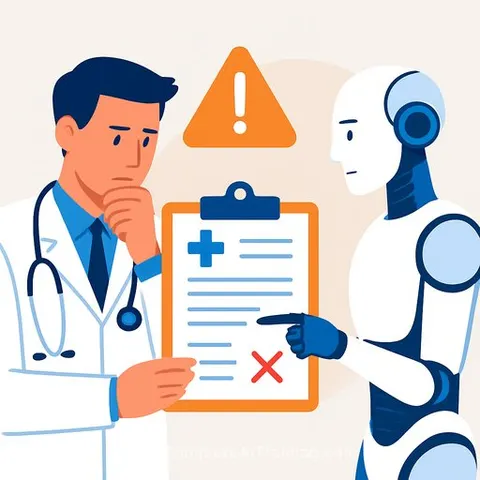
More than one in four physicians now use AI to document billing codes, medical charts or visit notes, according to the American Medical Association. But as health systems scale the technology from limited pilots to routine use, experts warn the documentation errors these tools introduce are hard to detect and could lead to medical mistakes and malpractice lawsuits - with clinicians legally on the hook for every error, regardless of whether AI generated the note.
"We've seen a lot of benefits in terms of work-life balance for providers," said Julie Massey, senior partner of digital and technology transformation at healthcare consulting firm Chartis. Still, research shows AI scribes produce significantly worse quality clinical documentation than humans. A study published in the Annals of Internal Medicine had human graders score primary care notes from 11 commercial AI scribe tools against notes written by 18 human clinicians. The AI-generated notes scored lower in all 10 quality domains assessed, with the largest deficits in thoroughness, organization and usefulness.
While no public malpractice cases tied to AI scribes exist yet, "that doesn't mean there are zero," said Bill Satterwhite, a practicing physician and licensed attorney who serves as principal of healthcare performance improvement at Huron Consulting Group. Lawsuits often take years to work through the legal system, especially those involving sensitive medical records.
How AI scribe errors happen
AI models operate via prediction, generating outputs by selecting the statistically most likely next word based on prior context. Because the process is probabilistic, the same AI scribe used for the same clinical visit will produce different notes each time. That unpredictability makes auditing far more difficult than with traditional software, which fails in consistent, predictable ways, Satterwhite said.
The specific mistakes that raise malpractice risk include missing clinical information discussed during a visit, transcribing medical terminology incorrectly, and fabricating information to fill gaps in an EHR template - what experts call hallucination. AI scribes may also omit non-verbal observations like facial expressions or tone, misinterpret vague patient statements, drop the context behind a clinical decision, or introduce racial bias.
Even more concerning, the technology won't flag these errors. If a patient says something unclear, an AI scribe resolves the ambiguity silently rather than alerting the provider. A human, by contrast, would be more "comfortable raising a question," said Jennifer Geetter, a partner at McDermott, Will & Schulte. Accuracy can also degrade over time. "It's like a knife that gets dull," Geetter said.
The rubber-stamp problem
Although providers are supposed to review, approve and sign off on AI-assisted documentation, the Texas Medical Liability Trust warns that clinicians may spend less time and effort reviewing notes as reliance on the tools grows. They could rubber-stamp notes without critical review, assume all important information was captured, or stop thinking critically about what was documented. Nearly 9 in 10 physicians worry that using AI will lead to skill loss, especially among early-career doctors, according to the AMA.
For healthcare organizations deploying these tools, the fundamentals of AI for Healthcare include understanding where the technology introduces risk, not just where it saves time. A patient could experience a negative drug interaction, for example, if an AI scribe omits information about medications the patient is already taking.
Steps to reduce liability
Experts recommend several precaution measures for hospitals and health systems:
- Start with a pilot to catch major issues before systemwide deployment.
- Approve products centrally rather than leaving the choice to individual clinicians.
- Include AI scribe use in consent forms and procedures.
- Treat AI-generated notes as a draft the clinician must verify before signing.
- Set documentation timetables so notes get reviewed while the visit is still fresh.
- Train staff on AI use and documentation, with refreshers whenever the system is updated.
- Use safeguards built into EHR systems, such as prompts to confirm medications, dosages and allergies.
- Audit notes on an ongoing basis, including after the pilot ends, to catch accuracy drift.
For professionals managing clinical documentation workflows, structured training like the AI for Medical Records Clerks learning path can help teams build review protocols that catch the specific failure modes AI scribes introduce.
Why this matters for healthcare professionals
The legal liability for AI scribe errors lands squarely on the clinician who signs the note, not the vendor who built the tool. Satterwhite put the core precaution plainly: "You need to think of AI scribing as being a copilot, not the pilot, not autopilot." For healthcare professionals, that means treating AI-generated documentation as a starting point that demands the same scrutiny as a trainee's notes - and building review workflows that account for the technology's tendency to fail silently, unpredictably, and with errors that are easy to miss.