
AI news ·
AI speeds up coding but delivery gains stall without fixing the full pipeline
AI tools are helping developers write code 30% faster, but delivery timelines aren't keeping pace. The bottleneck isn't coding speed-it's testing, integration, and release processes left unchanged.
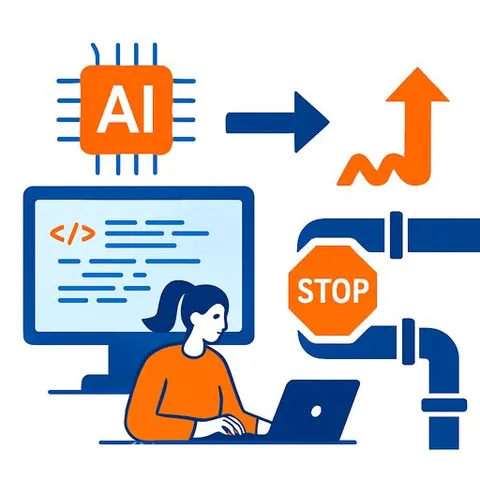
AI Is Making Developers Faster, But Delivery Isn't Improving
Software development teams are writing code 30 percent faster with AI tools. Sprint output is up. Individual productivity metrics look strong. Yet delivery timelines are not improving at the same pace, and in some cases they are becoming less predictable.
The problem is not the technology. It is where the technology is being applied.
Development speed is not the bottleneck
Organizations are investing heavily in AI coding tools and seeing immediate gains in how quickly developers work. But those gains do not translate into faster software delivery when the rest of the pipeline stays unchanged.
A recent client engagement showed this clearly. The company accelerated development but left testing, integration and release processes untouched. Defects were still detected late. Rework remained high. Teams spent time fixing inconsistencies introduced earlier in the lifecycle. The system had become unbalanced.
What looked like progress at the developer level was being offset by inefficiencies downstream. Faster code does not guarantee better delivery.
The real gains are in flow
When the focus shifted away from coding speed and toward testing and defect detection, results changed. Automated testing was refined to prioritize risk. Visibility improved across the delivery pipeline. Within a few cycles, rework dropped, sprint execution stabilized and delivery became more predictable.
The organizations getting measurable value from AI are not simply moving faster. They are reducing low-value effort, identifying issues earlier and improving how work moves through the system. Those three factors matter more than raw speed.
AI is reshaping the entire software development lifecycle. In planning, teams use it to process inputs more effectively and reduce ambiguity earlier. In design, it enables teams to explore architectural options before committing. In development, it improves how code is written, documented and maintained.
But the most significant changes are happening downstream. Testing is becoming more targeted and more intelligent, with effort focused where defects are most likely to occur. In operations, teams are moving from reactive support toward anticipating issues before they happen.
Why adoption remains uneven
Many organizations are not seeing results because AI is being adopted unevenly across the lifecycle. Development teams move quickly because the use cases are clear and the benefits are immediate. Earlier stages like requirements and design remain dependent on context and judgment, so adoption is slower.
This creates an imbalance where one part of the lifecycle is optimized and the rest is not.
Practical challenges also slow adoption. Tools are introduced without proper integration. Data is fragmented or unreliable. Teams are expected to use AI effectively without building the capability to do so. There is still hesitation about relying on AI in more complex scenarios.
None of this is a limitation of the technology. It is a reflection of how it is being implemented.
The developer role is already shifting
Less time is spent writing routine code. More time is spent reviewing outputs, validating decisions and managing how components fit together. The strongest developers are not those who can code the fastest. They are the ones who understand context, interpret requirements and make decisions across the system.
AI raises the baseline. It also raises the importance of judgment.
What technology leaders should prioritize
Improving developer productivity alone is not enough. The priority is improving how software is delivered.
- Embed AI into testing and quality processes
- Align tools with real workflows
- Invest in capability building
- Improve the quality of data that underpins decision-making
The next phase of competition will be defined by platforms, not individual tools. AI is moving into integrated environments that span planning, development, testing and operations. The question is no longer which tool a team uses. It is which ecosystem they build within.
AI will continue to make development faster. The advantage will go to those who design for how software is delivered, not just how it is built.
To build these skills across your team, consider exploring AI for Software Developers or AI Coding Courses that cover the full development lifecycle.