
AI news ·
AI tools show promise in early cancer detection, from blood cell screening to CT-based pancreatic diagnosis
AI models are detecting certain cancers earlier and more accurately than physicians alone, recent studies show. A Mayo Clinic model flagged pancreatic cancer up to three years before diagnosis; none are yet cleared for wide clinical use.
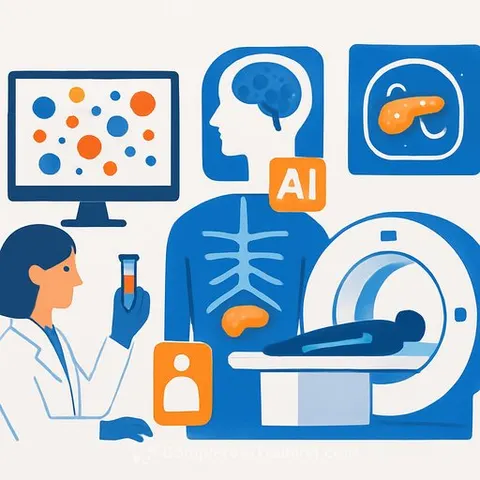
AI Models Show Promise in Early Cancer Detection
Researchers have demonstrated that artificial intelligence can detect certain cancers earlier and sometimes more accurately than physicians alone, according to recent studies cited by the Daily Caller News Foundation.
A 2024 randomized trial involving about 50 physicians tested access to GPT-4 for diagnostic tasks. GPT-4 acting independently scored highest, while physicians using the model as an aid scored second, and physicians working alone scored lowest.
Separate specialized algorithms have shown specific clinical applications. Researchers at the University of Southern California developed an algorithm that identifies a handful of cancer cells among millions of normal blood cells in roughly 10 minutes. A Mayo Clinic team built an AI model that flags pancreatic cancer on routine abdominal CT scans up to three years before clinical diagnosis-potentially meaningful given the American Cancer Society projects 67,530 U.S. pancreatic cancer diagnoses in 2026.
What Researchers Should Know
The reported results reflect two distinct technical approaches. Large language models like GPT-4 process text and image data to support diagnostic reasoning. Specialized systems rely on supervised deep learning trained on annotated medical images or cell samples, with performance depending heavily on dataset quality, label accuracy, and how well the training data represents real-world variation.
Early detection materially improves outcomes for many cancers, making gains in sensitivity or diagnosis timing clinically consequential. However, published research findings and pilot results are not equivalent to regulatory clearance or broad clinical adoption.
What Comes Next
Before these tools reach clinical practice at scale, they typically require:
- Prospective randomized trials measuring patient-level outcomes
- External validation across diverse patient populations
- FDA submissions or clearances
- Peer-reviewed publications detailing sensitivity, specificity, and false-positive rates
- Demonstration of integration with electronic health records and clinical workflows
- Reimbursement decisions and clinical guideline endorsements
For researchers evaluating these advances, focus on studies that report study design transparently, validate findings in independent cohorts, and measure actual clinical impact rather than laboratory performance alone.
Learn more about AI for Healthcare applications and explore AI Research Courses on diagnostic model development.