
AI news ·
Asian schools race to embed AI in classrooms as governments warn of falling behind
Asian schools are adding AI to classrooms as governments compete to build tech talent. China mandates AI instruction hours; South Korea calls it a "national survival strategy"; Japan is still watching pilots.
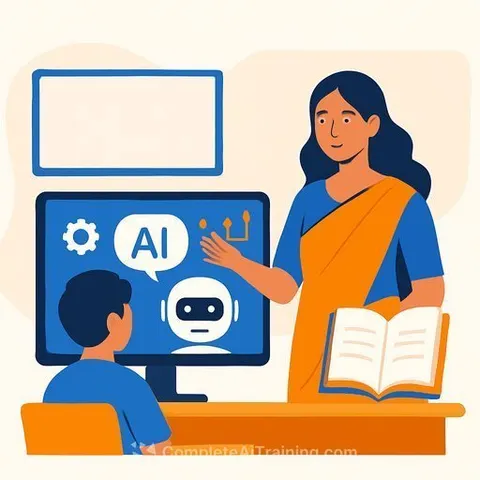
Asian schools embrace AI as governments race for technological edge
Schools across Asia are adopting artificial intelligence in classrooms as governments position their countries as AI powerhouses. The shift reflects a strategic calculation: nations that fail to build AI talent risk falling behind economically.
Singapore, China, and South Korea are leading the adoption, though their approaches differ sharply. China has made AI education compulsory in some regions, requiring eight hours annually in Beijing and six hours in Guangdong Province. South Korea frames AI talent development as a "national survival strategy." Japan, by contrast, is monitoring pilots cautiously before committing.
How students are using AI today
Anaiya Singhvi, a 15-year-old student in Singapore, uses Google's Notebook LM to understand chemistry concepts and summarize documents. She credits AI with making difficult subjects manageable, particularly before exams.
At her school, Saint Anthony's Canossian Secondary School, the chemistry department uses AI to analyze student errors and identify weak topics. Anaiya then focuses revision on areas where she struggles rather than reviewing everything.
Students across Asia are using AI for similar purposes: brainstorming essay ideas, organizing thoughts, and getting feedback on their work. But educators emphasize a critical distinction: students should use AI as a tool to support their thinking, not replace it.
The risk of offloading thinking
A January 2026 report by the Brookings Institution's Center for Universal Education found that AI's risks in education "currently overshadow" the benefits. The study surveyed 500 educators, parents, students, and technology experts across 50 countries and reviewed over 400 studies.
The main concern: students offload mental tasks to AI, undermining their cognitive development. If students ask AI to write essays or solve problems instead of working through them, they miss the learning process itself.
Singapore's Education Minister Desmond Lee framed the challenge directly: "With the potential of AI being so significant, all the more we need to ground our children and students in strong fundamentals."
He emphasized that students must learn to synthesize information, think inventively, and think critically-skills that require struggle and effort.
Different national strategies
China: The government sees AI education as essential to building an AI-driven economy. Schools teach programming, robotics, and coding. Students use AI to brainstorm and organize assignments. The rollout varies by province, with some regions mandating specific hours of instruction.
South Korea: After rolling out an ambitious AI textbook program that teachers resisted, the government revised its approach. The new plan, introduced in November 2025, starts smaller by creating AI-focused secondary schools linked to university programs. This measured rollout reflects lessons learned from the previous attempt.
Singapore: The government launched AI Singapore in 2017 to build national AI capabilities. The initiative works with schools to teach AI literacy and identifies high-ability students for advanced training. Singapore also aims to make its broader workforce "bilingual" in AI-fluent in both their professional domain and how to apply AI to it.
Japan: The Ministry of Education takes a neutral stance, monitoring pilot programs rather than mandating AI adoption. Officials are gathering evidence on whether generative AI genuinely improves student competencies before deciding on broader implementation.
Australia: Education authorities have released guidance on responsible AI use in schools. Many schools are taking a cautious approach, developing policies before AI becomes embedded in daily practice.
The timing question
Neil Selwyn, a researcher at Monash University studying AI in schools, argues that discussions should start with the purpose of education, then consider where AI fits. "AI last rather than AI first," he said.
AI is already entering schools through widely used platforms like Google Classroom. Students are increasingly using it for their studies. These tools are becoming part of the educational environment whether schools formally adopt them or not.
The conversation about AI in education, Selwyn said, needs to happen now-before it becomes so embedded that schools stop asking whether it serves their educational goals.
Learn more about AI for Education and how educators are using AI as a teaching tool.