Microsoft co-founder Bill Gates is warning that artificial intelligence is creating the "most turbulent time in human history," predicting massive job losses and economic disruption unless governments act quickly. In a nearly 6,000-word essay published Wednesday on his personal website, Gates said leaders are not prepared for the speed of AI's advance and called for urgent policy responses.
"In terms of equity, AI will either be the greatest equalizer ever invented, or the worst source of injustice. The challenge is monumental," Gates wrote. "Even under the best circumstances, the transition to this new AI era will be one of the most turbulent times in human history."
Gates is the latest tech executive to publicly raise concerns about AI's risks. He told The New York Times that industry leaders are privately worried but reluctant to say so publicly because of financial pressures. "In private, people who understand how good this stuff is, and how much better it's getting, they're very worried," Gates said, adding that executives are telling each other: "Hey, man, don't say that. It's bad for us - the next trillion dollars we're trying to raise."
No plan for the transition
Gates wrote that AI advances are moving at a "mind-blowing rate" and that the technology "for the first time can replace and exceed human cognition." He said the shift will be far more disruptive than the personal computer revolution, which took 20 years to reshape the workplace.
"Unfortunately, right now we are not preparing for it," Gates wrote. "I don't see evidence that leaders, experts, and communities are confronting the challenges adequately. There is no plan to ease the entry into the AI era."
He acknowledged that slowing AI development globally is unlikely. "If someone had a credible plan for slowing down AI advances globally, I would likely support it," Gates wrote. "However, I don't think that's going to happen. The geopolitical and economic incentives are pushing too hard to go full speed ahead."
Taxes and a 'human reserved domain'
Gates proposed several policy measures to cushion the impact on workers. He suggested taxing AI tokens, which companies use to track usage and bill customers, and taxing robots that replace human employees. "Right now, if you're an employer and you hire someone, you have to pay taxes on their earnings, but if you buy a robot, you can usually write it off right away as a business expense," he wrote.
He also proposed preserving certain jobs for humans, including caregivers, mental health workers, and some medical professionals. "Imagine a robot giving you the awful news that you have an incurable disease. There's no technical reason why it couldn't. Yet it shouldn't," Gates wrote.
For those working in the public sector, the essay raises questions about how government agencies will adapt to AI while managing its risks. Gates' call for federal action - and his criticism of current preparedness - directly touches on the responsibilities of policymakers and public administrators.
Expert: Right diagnosis, wrong prescription
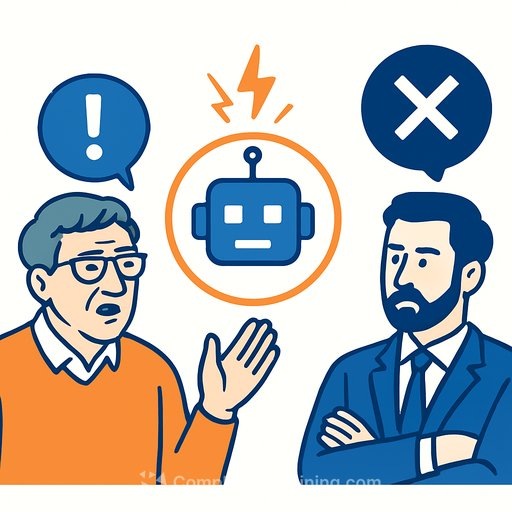
Oren Etzioni, a computer science professor at the University of Washington and founding CEO of the Allen Institute for Artificial Intelligence, said he agrees with Gates' assessment of the problem but not all of his solutions. "I think he has the diagnosis right, but the prescription wrong, at least in some places," Etzioni said.
Etzioni questioned the proposed tax on AI tokens. "I think that taxing tokens is like taxing keystrokes on a typewriter. It doesn't make sense. It measures effort, not displacement of workers," he said. He also warned that taxing AI usage in the U.S. could push development and adoption overseas. "If we tax American tokens, then what happens when people use Chinese models? Are we shipping AI use offshore with these taxes?"
Etzioni said existing agencies should enforce updated policies rather than creating new government bodies, and he urged pragmatism. "Even three years ago, we didn't know what was happening and how fast it was happening. So it's not too late now," he said. "Let's make sure that we act with urgency and pragmatism because it may well be too late three years from now."
Gates' essay arrives as the federal government begins to shape its approach to AI. In June, President Donald Trump signed an executive order requiring AI companies to share products with the federal government for evaluation before wider release. For government employees, the debate over AI policy is not abstract - it will determine how agencies deploy the technology and how they manage its effects on the workforce they serve. Understanding the arguments on both sides, from Gates' call for new taxes to Etzioni's caution about unintended consequences, is essential for those who will be asked to implement whatever rules emerge. For a deeper look at how public sector professionals can prepare, see this AI for Government resource or this AI Learning Path for Policy Makers.
Why this matters for government professionals
Gates' essay and the response from Etzioni frame the core policy debate that government employees will likely confront: whether to slow AI adoption through taxes and regulation, or to move quickly while managing risks through existing agencies. Public sector workers in policy, oversight, and program administration roles will need to understand both the technical realities of AI and the arguments for and against different regulatory approaches. The decisions made in the coming months - on taxation, agency authority, and workforce protections - will shape how AI is deployed across the public sector for years to come.
Your membership also unlocks: