Intern's AI Work Bridges Plant Biology and Robotics at Brookhaven Lab
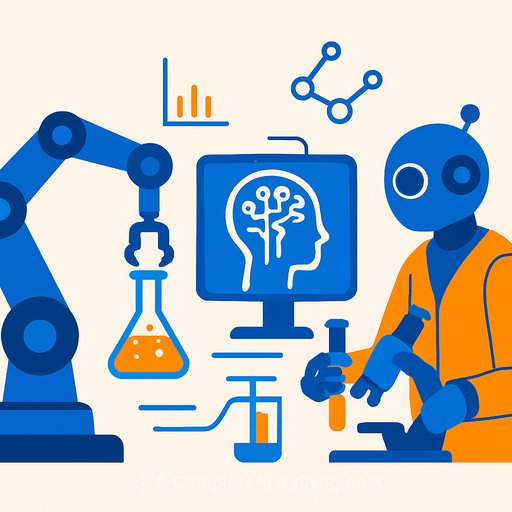
Jasmin Lin spent her internship at Brookhaven National Laboratory developing artificial intelligence systems that solve practical problems: how to let robots maintain a particle accelerator without shutting down the X-ray beam. Her work integrated virtual reality with plant digital twins, trained humanoid robots to walk in simulation, and deployed vision-language-action policies to control physical robots performing maintenance tasks.
Lin, now pursuing a master's degree in bioinformatics at Brandeis University, completed her initial internship from January to May through the Science Undergraduate Laboratory Internships (SULI) program. She worked under Wei Xu in Brookhaven's Computing and Data Sciences Directorate, contributing to the Department of Energy's Genesis Mission to accelerate AI innovation.
Virtual Reality Meets Plant Models
Lin's first project connected VR with a 3D digital twin of a plant. She could point and click within the virtual environment to access the original images used to generate specific elements of the model. This approach let her trace visual data back to its source, validating the accuracy of the digital reconstruction.
A digital twin, as Lin defines it, is a "dynamic, real-time digital model of a physical system that continuously updates alongside the real counterpart." For computational biologists, this means moving beyond 2D screens to explore plant structure in immersive 3D space.
Traditional methods require researchers to sift through large datasets and complex models on flat displays. VR offers a more direct way to interact with this information. The work demonstrates how embodied AI-where systems learn through interaction with environments-can accelerate research in plant physiology, genetics, and environmental adaptation.
Training Robots to Walk
Lin used the SKRL reinforcement learning library to train humanoid robots to walk and balance in simulated environments. SKRL's modular design let her test different learning policies quickly, cutting development time significantly.
Reinforcement learning typically requires robots to learn through repeated trial and error, a computationally expensive process. Pre-built libraries like SKRL let researchers focus on specific behaviors rather than rebuilding fundamental learning algorithms from scratch.
The practical application matters: if a robot can navigate the accelerator tunnel at NSLS-II, maintenance work no longer requires shutting down the X-ray beam. "If maintenance or repairs require workers to go into the accelerator tunnel, the facility must turn off the X-ray beam," Lin said. "But if we can train a robot to go into the accelerator tunnel, that would prevent the need to turn off the beam and reduce down time."
From Simulation to Physical Robots
Lin's current work deploys vision-language-action policies-AI models that let robots "see, understand instructions, and act" in coordinated ways. She started with a basic task: training a robot to pick up a 3D mockup of a motherboard and place it in a box.
She is now integrating VR for remote operation in simulation before moving to real-world deployment. This staged approach-simulation first, then physical implementation-ensures safety and reliability within the facility.
Troubleshooting robotics presents multiple layers of difficulty. "Whenever there's an issue, you can't really pinpoint where it starts from," Lin said. "There's hardware in the robot, there's software in the robot, and there's also software on the computer connection and deployment of the AI model that we're using."
From Biology to AI
Lin's shift from bioinformatics to embodied AI reflects a broader trend in research. After her SULI internship, she continued through the Supplemental Undergraduate Research Program (SURP), focusing on how robots can assist user facilities across Brookhaven Lab.
She observed that AI has become more reliable over the past year, with fewer hallucinations and irrelevant responses. This improvement matters for practical applications where accuracy directly affects task success.
"I love that there's a lot we can explore because it's relatively new, especially with a shift and focus on embodied AI right now," she said. Her work shows how hands-on research experience can rapidly expand a scientist's skillset across disciplines.
For researchers interested in the intersection of AI and scientific discovery, AI for Science & Research courses cover applications in laboratory optimization, research automation, and computational biology-the core areas Lin's work addresses.
Your membership also unlocks: