
AI news ·
Chinese schools add emotional education classes to prepare children for AI-driven job market
Four in five wealthy Chinese parents fear AI will cost their children jobs, a Fudan University survey found. Shanghai schools are responding by adding weekly classes in empathy, ethics, and collaboration - skills machines can't replicate.
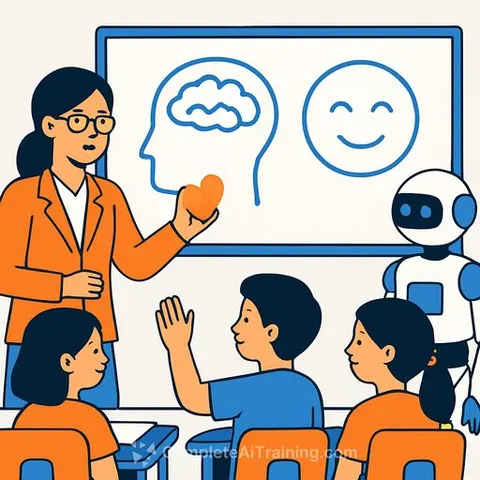
Chinese Schools Add 'Emotional Education' as Parents Fear AI Will Disrupt Job Market
Four out of five wealthy parents in China worry that artificial intelligence will threaten their children's future job prospects, according to a survey published by Shanghai's Fudan International School of Finance in April. One in five parents said they have no idea how to prepare for the changes.
The anxiety is driving schools across Shanghai to rethink what they teach. Instead of focusing solely on academic knowledge, educators are building "emotional education" classes into the curriculum - courses designed to develop empathy, ethics, collaboration, and other traits machines cannot replicate.
Wu Rongjin, principal of Shanghai Huangpu Luwan No 1 Central Primary School, explained the reasoning: "In the legal field, AI can read thousands of pages in seconds but doesn't understand justice; and AI in medicine can diagnose health conditions but cannot hold a patient's trembling hand."
What Schools Are Actually Doing
Primary schools in Shanghai's Huangpu and Jiading districts now require weekly emotional education classes. Teachers focus on self-awareness, emotional management, empathy, and interpersonal communication. One recent exercise asked students to nominate "unsung heroes" around them - peers who showed kindness but didn't earn academic accolades.
Teachers at the school said they installed corridor cameras to monitor safety. The cameras now serve a different purpose: capturing moments of students helping each other. These recorded acts of kindness become discussion topics in emotional education classes.
At kindergarten level, teachers are changing how they handle conflicts. Instead of ruling on disputes, educators encourage children to express themselves and then switch roles to describe the situation from another perspective. This builds communication and collaboration skills.
Some schools are using technology itself as a teaching tool. Primary school students in Shanghai's Huangpu district used large language models to create movie descriptions for the visually impaired. Teachers said the project taught both technical skills and a lesson: technology should serve human welfare.
Parents Are Shifting Priorities
The Fudan survey found that 60 percent of parents now prioritize soft skills - character building, interpersonal communication, and problem-solving - over securing admission to top universities, which 43 percent still rank first.
Wang Shuangchen, a 39-year-old book editor from Chongqing, enrolled her 12-year-old son in a public speaking course after discussing the decision with him. "Even though AI tools can assist in writing a speech draft, there is still a significant difference in the personal charisma each individual displays when speaking on stage," she said.
Lu Yiyi, a Shanghai mother and graphic designer, started letting her 11-year-old daughter take the subway to school alone - a 60-minute journey involving transfers. "Communication skills and the capacity to tackle real-world challenges are not what kids can learn at school through exams," Lu said. "They are developed via real experiences like these."
What Experts Say Students Need
Education experts agree on a core set of abilities that matter for an AI-driven future: adaptive problem-solving, independent critical thinking, logical reasoning, and emotional intelligence. These qualities should be developed alongside lifelong learning habits and the ability to acquire new skills continuously.
Michael Levitt, the 2013 Nobel laureate in chemistry, told the World Laureates Forum 2025 in Shanghai that the next generation will create AI rather than simply use it. "They will expand what's possible for the good of society and humanity," he said.
Wu, the school principal, emphasized that Chinese cultural values - humility, diligence, perseverance, and a thirst for knowledge - should be highlighted in emotional education. Her school encourages students to cook traditional Shanghai dishes, recognizing that mastering a skill builds confidence and strengthens family relationships.
Zhao Zizi, a Shanghai middle school teacher with three decades of experience, offered perspective on AI's role: "AI is just a tool to help us get closer to people who we admire and are worth learning from. It is not a 'person' a child can aspire to emulate."
For educators looking to adapt their teaching methods, resources like the AI Learning Path for Teachers offer practical guidance on integrating AI awareness into curriculum design.