
AI news ·
Copyright office says AI-generated work can be original but AI cannot be an author
The Indian Copyright Office ruled an AI-generated artwork can meet the originality test for protection, but rejected DABUS as legal author and denied Stephen Thaler's registration after he refused to name himself instead.
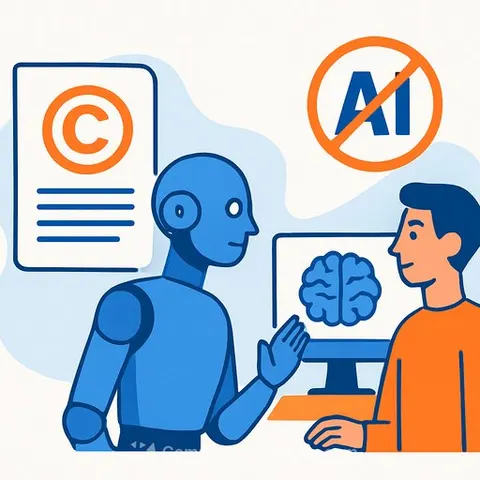
Copyright Office separates originality from authorship
The Indian Copyright Office has ruled that a work generated through an algorithmic process can satisfy the originality requirement for copyright protection, even without real-time human intervention. At the same time, the Registrar of Copyrights held that an AI system cannot be recognised as the legal author under the Copyright Act, 1957.
The order, passed on August 31, 2026, came in an application filed by Dr Stephen L. Thaler seeking registration for the artwork A Recent Entrance to Paradise. Thaler had named DABUS - the "Device for the Autonomous Bootstrapping of Unified Sentience" - as the work's author.
Originality and authorship are distinct questions
The Copyright Office drew a clear line between the originality of a work and the legal identity of its author. Applying the Supreme Court's test in Eastern Book Company v. D.B. Modak, the Registrar found that the artwork met the limited threshold of originality under Section 13 of the Act.
The Office determined that the composition had not been predetermined in its final form, was not shown to reproduce an identified pre-existing work, and contained the minimum degree of expressive creativity necessary for protection. The use of algorithmic or computational processes, the Registrar held, cannot by itself make the resulting expression unoriginal.
Section 2(d)(vi) defines the author of a computer-generated literary, dramatic, musical or artistic work as "the person who causes the work to be created." The Registrar said this inquiry concerns legally attributable causation rather than merely identifying the technological mechanism that generated the output.
DABUS rejected as author, Thaler declines to amend
On the facts disclosed by Thaler himself, the Office noted that he had conceived and created DABUS, configured its operation, supplied visual inputs comprising photographs he took, curated linguistic inputs, provided descriptions connecting the material, and initiated the generation process. The Registrar found that Thaler, not DABUS, was the person who caused the particular work to be created.
DABUS has no recognised natural or juristic personality under existing law and therefore cannot be entered as an author under Section 2(d)(vi), the Office said. Despite the finding that the artwork met the originality threshold and that Thaler was capable of being identified as its statutory author, the registration application was ultimately rejected.
Thaler had been given an express opportunity during proceedings to amend the authorship particulars and identify himself as the author. He declined, maintaining that DABUS should remain listed as author. The Registrar held that the existing particulars were legally inconsistent with Sections 2(d)(vi) and 17-19 of the Copyright Act.
The rejection does not prevent Thaler from pursuing remedies available under law with particulars that correctly identify the author and corresponding ownership. The order also said that any extension of legal personhood or authorship to autonomous AI is a policy question reserved for Parliament.
Implications for generative AI in India
The ruling matters for businesses deploying generative AI across advertising, entertainment, gaming, animation, design, publishing and other content-led industries. Thaler's legal team said the decision provides clarity by distinguishing copyrightability from authorship, and that its significance lies in recognising that the absence of real-time human determination of the final expressive form does not, by itself, place an AI-generated output outside copyright protection.
They contrasted the Indian approach with the position in the United States, where the same artwork has been at the centre of litigation over the requirement of human authorship. The Copyright Office, however, confined its determination to the facts before it, observing that it was neither necessary nor appropriate to rule on every form of AI-assisted creation because the nature and degree of human involvement could vary materially across systems and works. For legal professionals tracking how AI for Legal applications intersect with existing statutes, the order offers a useful reference point.
Why this matters for legal professionals
The ruling gives lawyers a concrete framework for advising clients on AI-generated content: originality is assessed on the output itself, while authorship depends on who caused the work to be created. Practitioners drafting copyright applications for AI-assisted works should ensure the named author is a natural or juristic person with a defensible claim to having caused the creation. Those working on document review or IP filings involving generative AI may find the structured analysis in the AI Learning Path for Paralegals relevant to applying this distinction in practice. The order also signals that Parliament, not the Copyright Office, will decide any future expansion of legal personhood to autonomous systems.