
AI news ·
CSU faculty union pushes bill to prevent AI from replacing professors
A California bill barring CSU from replacing faculty with generative AI advances with no opposing votes. The system has a $13M annual contract with ChatGPT.
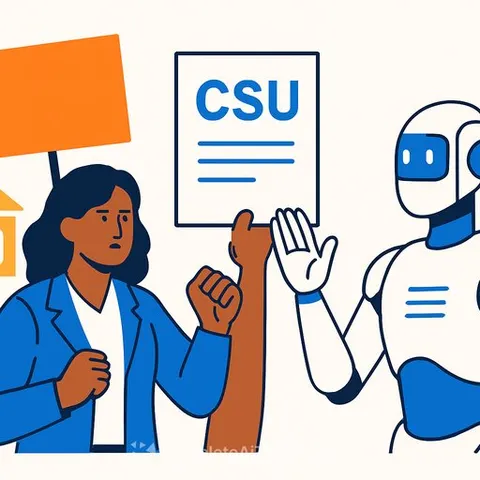
A bill that would bar the California State University system from replacing faculty with generative artificial intelligence is advancing through the Legislature without a single opposing vote so far. The union representing CSU professors, counselors, and coaches is pushing the measure as the 23-campus system deepens its investment in AI tools, including a multimillion-dollar contract with ChatGPT, and as labor disputes flare over how the technology can be used.
"I personally am very concerned about closing the barn door after the horse has already gotten out," said Kevin Wehr, a sociology professor at Sacramento State who leads the bargaining team for the California Faculty Association. "We're trying to keep ahead of a rapidly changing set of technologies."
Union files unfair labor practice charges over AI chatbots
Tension turned into formal complaints last winter when the union accused Sacramento State of trying to replace some faculty work with AI. The union's filing with the state labor board alleged that the campus's then chief AI officer, Alexander Sidorkin, created a mental health chatbot for students and published a link on a resource page with the statement, "AI is better than nothing, when a counselor isn't available."
Sidorkin, now a professor of education and a union member, denied developing any such bot. "It's a misstatement of the fact," he said. He said he had only recommended that students use ChatGPT if they couldn't reach a counselor. "I am disappointed in my union," he added. The system and the union settled in March, with Sacramento State agreeing to bargain before deploying bots that perform bargaining unit work or evaluate faculty.
The complaint also stated that Sidorkin solicited faculty for course syllabi and materials to build customized AI tutoring bots. Some 18 professors submitted material on the first day, Sidorkin said, before campus leaders told him to retract the request. A system survey later found that more than half of faculty said AI was affecting their teaching negatively, highlighting the friction in AI for Education adoption.
Faculty worry about AI expanding into grading and class size
Without clear boundaries, instructors fear that campuses could shift more grading to AI and then enlarge class sizes, reducing the need to hire additional professors. Patrick Oberle, an associate professor of geography at Sacramento State, said the union wants to make sure any use of AI to replace labor triggers a conversation with faculty first. "We're trying to accommodate the folks who are deeply opposed to AI's very existence, and also accommodate the folks that are very excited about all of its possibilities," he said.
The bill's author, Senator Sabrina Cervantes, said at a June hearing, "Many institutions of higher education are exploring options to integrate AI into their courses and curriculum. In many instances, this has been done without any boundaries or guardrails." The legislation could pass as soon as Monday.
California lawmakers weigh broader workplace AI restrictions
Cervantes' measure is one of several in Sacramento aiming to rein in AI's role at work. Senate Bill 947 would prevent employers from relying solely on AI tools to discipline or fire workers. Senate Bill 903 would ban psychotherapists from offering therapy through chatbots. Business groups, including the California Chamber of Commerce, oppose both bills, while unions back them. Governor Gavin Newsom vetoed a similar worker-protection bill last year.
Cal State has no position on the faculty replacement bill, but AI's role remains a sticking point in ongoing labor contract negotiations. The system signed a $17 million contract with ChatGPT last year and renewed its contract with ChatGPT for $13 million annually over three years, according to LAist. The California Faculty Association has donated at least $3.4 million to state candidates since 2020, including $64,650 to Cervantes since 2016, according to Digital Democracy data.
Why this matters for education, IT and development professionals
The CSU conflict shows that AI adoption in large institutions can quickly trigger labor and regulatory fights, not just technical conversations. For IT and development teams building or deploying AI in higher education or other unionized sectors, the lesson is that how the tools are rolled out matters as much as what they do. Contracts, bargaining obligations, and employee pushback can shape implementation timelines and feature choices, making it critical to design systems that augment human work rather than replace it from the start.