
AI news ·
Educators weigh AI's role in the classroom as Pope Leo XIV calls for human-centered approach
Colleges are adding AI to classrooms but struggling to balance efficiency gains against the risk of students faking competence and bypassing real learning. Professors say mentorship and human formation can't be replaced by any tool.
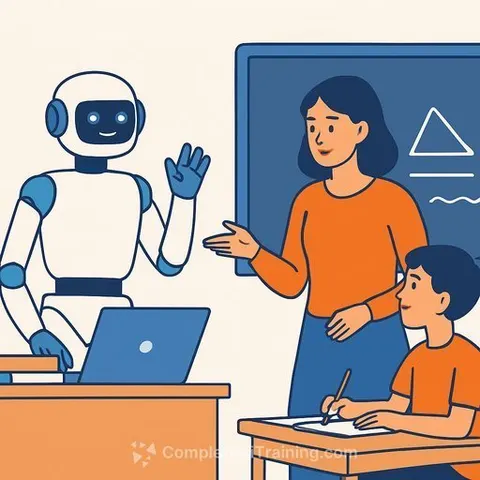
Educators Debate AI's Role in the Classroom
Colleges and universities are integrating artificial intelligence into teaching while grappling with a fundamental tension: AI tools can boost efficiency, but they risk replacing the human relationships that define education.
Fernanda Psihas, a data science and physics professor at Franciscan University of Steubenville, said instructors must become AI-literate or risk students faking competence. "If instructors are not AI-literate, then classrooms are going to run the risk of drifting into having students faking competence and avoiding the actual learning," she said.
Yet Psihas emphasizes that AI cannot replicate mentorship. "Education is a lot more than just skills and information-transfer, but it's actually the formation of the whole person," she said. "There's guidance. You guide and nurture the students' curiosity and their skills."
Managing Academic Integrity
Psihas uses AI to test her own assignments before students see them. She runs assignments through AI tools to see what responses the technology generates, then adjusts problems accordingly. This approach lets her detect when students submit AI-generated work.
AI also handles grading for multiple-choice tests and data production. But Psihas draws a clear line: "Use it to increase efficiency so you can focus on the learning, but if you do any more than that, you're actually destroying the learning process."
Age Matters in Technology Use
An Chih Cheng, a professor at DePaul University's College of Education, said the risks of AI exposure vary significantly by age. Young children spending time on screens face developmental concerns. "Screen time for children is passive learning and is devoid of social aspects that are critical for communal development," he said.
Teenagers face different risks, particularly from social media. Cheng noted that digital harm "has caused harm to individual teenagers in particular, even suicide."
Higher education institutions are adopting AI with minimal oversight. California State University signed a $13 million contract with OpenAI without clear guidance on how students should use the tools. "If you just have the chatbot open there, it is absolutely not helpful for meaningful learning," Cheng said.
Teaching Students to Think About Technology
Some educators are embedding AI into coursework to help students develop critical judgment about the tools themselves.
Paolo Carozza, a Notre Dame Law School professor, requires students in his law and technology seminar to upload scholarly papers into AI tools, then write essays comparing their own analysis to the AI's output. Students reflect weekly on whether the technology helps or hinders their thinking.
"By the end of the semester they really had thought very deeply, in a continuous way, about their relationship to technology, what the appropriate limits were for themselves, and what to be cautious about," Carozza said.
Cheng uses AI in his research methods class to help students brainstorm questions and access statistical analysis tools that would otherwise be too expensive. He also employs visual AI simulations so future teachers can observe child development virtually.
The Core Question
Carozza frames the central issue as one of human formation. "The deeper challenge for educators is providing our students with a fundamental human formation that allows them to really think about what their personal relationship to technology is in their lives and how it affects it."
Psihas calls this a "values-first approach" to AI. The goal is not to reject the technology or pretend it doesn't exist, but to ensure students develop the judgment to use it appropriately.
For more resources on integrating AI responsibly in education, see AI for Education or explore the AI Learning Path for Teachers.