
AI news ·
Fed raises rates for first time since mid-2023 as inflation proves stubborn, Richmond Fed president says
The Fed raised rates for the first time since mid-2023, citing tariff costs, pricier gasoline, and an AI investment surge that keeps technology equipment costs elevated.
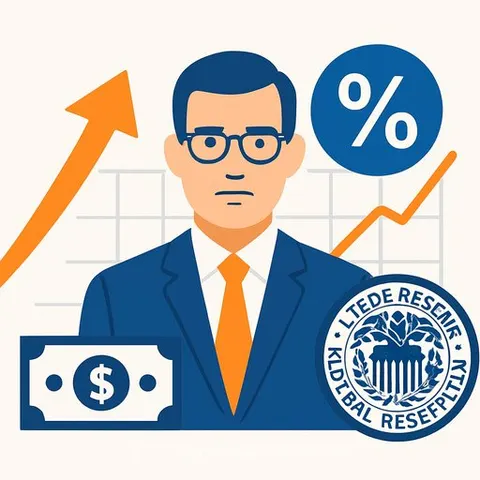
Federal Reserve officials are confronting an inflation picture that no longer looks temporary. Richmond Fed President Tom Barkin said last week's rate increase - the first since mid-2023 - reflects a reality where tariff costs, higher gasoline prices, and an enormous wave of AI investment are pushing up prices for technology equipment with no clear end in sight.
Speaking Thursday at an Economic Club of Washington, D.C., event with Barbara Humpton, CEO of USA Rare Earth, Barkin described a shift in the central bank's thinking. Six months ago, he said, it was easier to argue that inflation's persistence would fade. That argument has weakened.
"If inflation's not going to come down relatively quickly," Barkin said, "then you have to look in the mirror and say inflation looks like it's been here for a while."
The log flume problem
Barkin used a water-park metaphor to describe the challenge facing Fed Chair Kevin Warsh. "You go slowly up the hill of the last ramp, and then you go full speed down into a pool of water, and the pool of water comes and soaks the guy in front," he said. "That's Kevin Warsh or Jay Powell. The rest of us are in back. Our hands are in the air."
The image captures the bind: rates are moving higher as inflation persists, while AI investment reshapes both prices and the labor market simultaneously. Barkin said he had "the deepest respect for anyone who would be foolhardy enough to take on the leadership of the Federal Reserve System."
AI investment cycle reshapes hiring
Barkin described an economy in the middle of an enormous AI investment cycle. Companies are spending aggressively on the expectation that AI will lift productivity, but that same expectation is making them more cautious about hiring. The technology is already in use for coding, call centers, compliance paperwork, and engineering.
Strong corporate earnings are working against layoffs, however. Companies with deep backlogs of technology projects would rather redeploy freed-up capacity than cut headcount, said Barkin, a former McKinsey CFO. The harder problem is organizational. "The unit of an AI-enabled task is not precisely the same as a mid-level manager and what they do," he said.
Many firms can see how AI makes individual tasks more efficient but have not figured out how to translate that into a redesigned staffing model. For senior leaders navigating this shift, AI Senior Leadership Courses address the organizational design questions that task-level efficiency alone cannot solve.
Barkin also raised a less obvious possibility: AI could lower barriers to entry in skilled trades. He pointed to auto mechanics, where an AI assistant could give a less-experienced worker a real-time checklist to compensate for missing expertise. "I think there's a lot of talk about the AI apocalypse," Barkin said. "We're clearly not yet there."
CFO confidence splits by company size
Separate data from the Richmond Fed, Atlanta Fed, and Duke University's Q3 2026 CFO Survey shows optimism heading into 2026 and 2027 splitting sharply along company size. Large firms are raising expectations for revenue and hiring growth. Small and financially constrained companies are pulling back, with 20% saying they cannot cover costs or pursue new business - more than double the rate at large firms.
Fewer companies overall plan to invest in equipment or facilities over the next six months. One in five finance chiefs now names interest rates and the risk of further hikes as a top concern, alongside inflation, tariffs, and labor quality.
Why this matters for executives and finance leaders
Barkin's comments signal that the Fed sees AI investment as a structural force in the economy, not a passing trend. For CFOs and strategy leaders, the implication is twofold. First, capital allocation decisions must account for persistently higher rates and equipment costs driven partly by AI infrastructure demand. Second, the organizational challenge Barkin described - turning task-level AI efficiency into a coherent staffing model - is now a boardroom issue, not an IT project. Companies that solve it will redeploy talent. Those that do not will pay for underutilized headcount while competitors pull ahead.