
AI news ·
Florida Republicans break with Trump to push for state-level AI regulation
Florida Republicans running for governor, including Trump's preferred pick Byron Donalds, are pushing for state-level AI rules over a federal framework. Their stance defies both Trump and tech donors amid voter fears over job losses and AI safety.
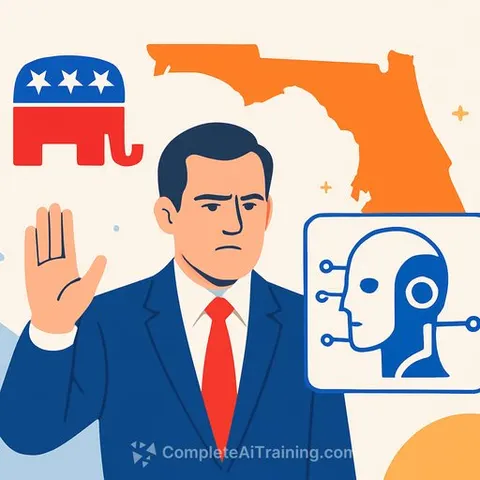
Florida Republicans Push Back on Trump's AI Stance, Buck Tech Money
Rep. Byron Donalds, Trump's pick to succeed DeSantis as Florida governor, said Monday he disagrees with the president on how to regulate artificial intelligence. While Trump has called for a national framework, Donalds wants states to lead - a position he's taking despite receiving at least $5 million in campaign support from Leading the Future, a pro-AI political action committee.
Three other Republican gubernatorial candidates - former state House Speaker Paul Renner, Lt. Gov. Jay Collins, and investor James Fishback - have also pledged to maintain state-level AI restrictions. Their stance signals that Florida Republicans are willing to defy both Trump and tech industry money to address voter concerns about job displacement, data center locations, and cybersecurity threats.
Voter concern is reshaping candidate positions. Brendan Steinhauser, a consultant and president at the Alliance for Secure AI, said polling shows voters are unsettled by automation and the potential for advanced robotics to eliminate jobs. "People are seeing that and the politicians reflect public opinion," he said.
Trump, by contrast, recently postponed signing an executive order that would increase federal AI oversight. He has expressed concern that stronger regulations could slow U.S. technological development relative to China. The White House did not respond to requests for comment.
Florida's Legal Push Against OpenAI
Florida's Attorney General filed a civil lawsuit against OpenAI this year, seeking to hold the company accountable for what the state alleges are unfair business practices. The complaint centers on ChatGPT's lack of age verification and parental consent requirements for data collection from minors.
The lawsuit was prompted by two high-profile cases. A 20-year-old Florida State University student, Phoenix Ikner, allegedly used ChatGPT to research how to conduct a campus shooting. He is accused of killing two people and wounding six others. A University of South Florida student, Hisham Abugharbieh, is accused of using ChatGPT to plan the disposal of a body before the disappearances of two classmates.
OpenAI maintains that "ChatGPT is not responsible for this terrible crime." The company did not respond to a request for comment on the lawsuit.
Legislation Stalled in Republican-Led House
DeSantis proposed comprehensive AI legislation earlier this year that would have required chatbot platforms to share all user interactions with parents and allow parents to limit children's usage. The bill passed the state Senate twice with bipartisan support.
The Republican-led House never brought the measure to a committee hearing. House Speaker Daniel Perez said he spoke with "many" members who opposed the bill. Incoming Speaker Sam Garrison told reporters the House wanted to defer action so "the federal government can take the lead."
Even House Republicans who blocked the bill left room for future state action. "If that doesn't happen," Garrison said, "well then, ultimately, the state's gotta do what we have to do."
State Sen. Erin Grall, the lone Republican who voted against the legislation, argued it was too weak. She said the policies would do a "terrible job" regulating technology and would lull parents into a false sense of security.
For government professionals navigating AI policy, understanding both the regulatory landscape and public concerns is essential. AI for Government courses can help officials understand the technology's capabilities and risks. Similarly, ChatGPT Courses provide insight into the specific tools at the center of current regulatory debates.