
AI news ·
Game developer's sales quintuple after dropping AI, but the industry splits over where to draw the line
A solo developer added "no generative AI used" to his Steam page and watched monthly sales jump from under 300 to 2,000 copies. His eight-month rebuild replaced AI-generated art with hand-drawn work and self-written dialogue.
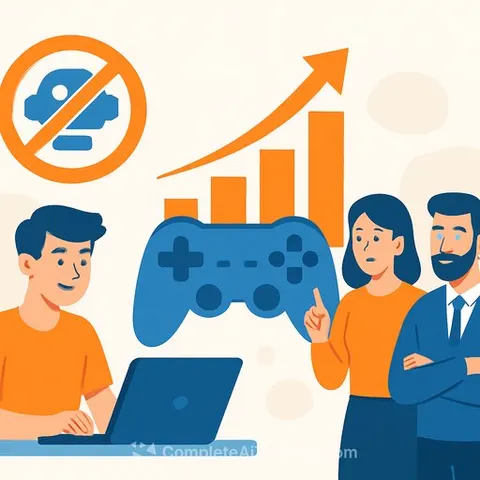
Game Developer Quintuples Sales by Rejecting AI-And Players Are Following
Chen Mo, a 41-year-old independent game developer, added a single line to his Steam page: "All the content of this game is hand-crafted by humans, and no generative AI is used." His sales jumped five times.
The shift came after he rebuilt his game from scratch. He had initially used generative AI for concept art, copywriting, and character illustrations. The first version sold fewer than 300 copies in a month. When a player wrote that the art looked good but playing it felt like "eating plastic bags," Chen Mo realized the criticism was valid.
He spent eight months remaking the game with a newly hired art student, writing every line of dialogue himself. "Sometimes I only wrote three lines a day, but those three lines were what I really wanted to say," he said. The relabeled version now sells 2,000 copies monthly.
The Market is Splitting
Chen Mo's success reflects a growing divide in the game industry. In December 2025, the game "Light and Shadow: Expedition 33" won Game of the Year and Best Debut Game at the Independent Game Awards. Hours later, the developer admitted to using generative AI during development. The awards were revoked.
The backlash was swift. Players flooded forums with complaints: "I spent so much money, and you tell me that what I've been getting are 'AI body parts.'" One petition on Steam demanded a filter to identify AI-generated games.
Yet the numbers tell a contradictory story. According to the 2026 Game Developers Conference survey, 52% of developers now see AI as harmful to the industry-up from 18% in 2024. Meanwhile, 7,818 AI-powered games exist on Steam, and 20% of newly released games in 2025 used AI technology, an 8-fold increase from 2024.
How Sales Professionals Should Read This
For sales teams, Chen Mo's case offers a direct lesson: customer perception of authenticity drives revenue. His "zero AI" label wasn't just marketing-it was a credible differentiator backed by actual product changes. Players could sense the difference.
The broader takeaway for AI for Sales professionals: transparency about how products are made matters. Hiding AI use risks exposure and backlash. Disclosing it clearly-and backing it up-can become a competitive advantage.
The Industry Splits Into Two Camps
Lin Yuan represents the opposite approach. A game producer in Beijing, he has built a studio of 40 people, including 12 dedicated "AI trainers" hired in 2024 to debug and optimize AI-generated content. He uses AI for side quests and background materials while keeping core plots human-written.
"Whether a game is fun is the most important thing. Whether AI is used or not is just a choice for people," he said.
Chen Mo disagrees. "Efficiency is the religion of AI, but my religion is 'existence'-having existed, having touched with hands, having drawn with a pen."
Evaluation Standards Are Shifting
The industry's response is fragmented. In 2025, some game media outlets began including "whether AI is used" in their scoring criteria. The weight is small, but the signal is clear: disclosure matters.
Developers now face a strategic choice: admit AI use and risk boycotts, or hide it and risk exposure. Neither option is clean.
Quality issues are mounting. NetEase's "Beyond the World" featured characters with three-section arms. Activision Blizzard's "Call of Duty" included a six-fingered zombie in its loading screen. These errors damage trust-and sales.
The Real Cost: The Death of Excellence
Lin Yuan described a "passing line" theory. A game that is simply fun scores 60 points-the comfort zone for AI. A truly excellent game scores 100 points, which requires human creativity AI cannot yet match.
The problem: more 60-point games flood the market, but the number of 100-point games hasn't grown. Worse, teams that could reach higher scores are choosing not to compete once the passing line is easily filled by AI.
"When efficiency becomes the creed, will 'creation' be the next forgotten concept?" Chen Mo asked.
For sales professionals, the lesson extends beyond games. As AI tools become cheaper and faster, the market will fill with adequate products. Those who bet on excellence-and can prove it-will command premium prices. Chen Mo proved it. The question is whether others will follow.