
AI news ·
German directors face personal liability under EU AI Act as most business leaders remain unprepared
German directors face personal liability under the EU AI Act on August 2, 2026 over HR tools. With 59 percent of leaders unprepared, companies must assess AI risks.
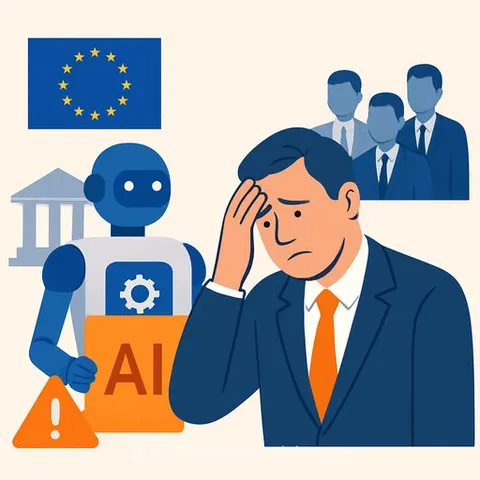
German managing directors face personal liability from August 2, 2026, when the EU AI Act becomes binding for all companies using artificial intelligence, legal experts warn. The risk lands squarely in HR departments, where AI tools are already screening candidates, automating background checks and onboarding employees - even as 59 percent of executives say their own leadership is unprepared for the upheaval.
Personal liability lands on directors' desks
Legal specialists highlight that directors may be held privately liable if their organisations fail to complete the required risk analysis and employee training around AI. The obligation cuts across sectors, but it hits human resources and executive search with particular force. Heiner Thorborg, a veteran personnel consultant, described the technology's impact plainly. "AI," he said, "now compresses a candidate-search process that once took weeks into mere minutes." Background checks can be fully automated, and Thorborg argued the shift creates something approaching a level playing field between small firms and the established global headhunting giants - Spencer Stuart, Heidrick & Struggles, Russell Reynolds, Egon Zehnder and Korn Ferry. Those big names, he added, are steadily losing market share, squeezed by conflicts of interest and over-diversification into coaching and management audits. For directors overseeing these tools, the liability clock is ticking. AI Learning Path for Managing Directors addresses the risk analysis and training requirements that now determine personal exposure.
HR's readiness gap widens
Companies are building internal recruiting capabilities to reduce reliance on external consultants. Deutsche Telekom, for instance, has been pushing in-house solutions. A Roland Berger survey of executives captures the strain: 62 percent expect major AI-driven upheaval, yet only 38 percent have actively started the transformation. The top barriers reported are a lack of AI skills (49 percent), unsuitable organisational structures (37 percent), and the starkest figure - 59 percent of respondents describing their leadership as insufficiently prepared. This gap is not just strategic; it is a legal vulnerability. When AI tools are used in hiring, assessment and workforce planning, the duty to perform risk analyses and train employees on those systems sits squarely with the employer. AI for Human Resources connects teams to the compliance and upskilling demands that the Act now makes urgent.
Operational risks inside teams
Even when AI is deployed, new risks emerge. Research from Boston University and BCG found that when AI agents are institutionalised as team members, direct human control drops by 16 percent and error detection declines by 18 percent. A separate warning from learning-and-development specialists Janine Kappenberg and Rubén Leites García points to what they call a "good-enough trap": if operational departments without didactic expertise create AI-generated learning content, quality suffers severely. Learning, they caution, is often reduced to pure information transfer, while reflection and feedback fall by the wayside. For HR teams rolling out AI-driven learning platforms, the trap is tangible - compliance training that ticks a box but fails to build real competence.
Co-determination and the shifting legal ground
Labour lawyer Volker Görzel clarified the current legal position. A works council's right to co-determine under paragraph 87, subsection 1, number 6 of the Works Constitution Act applies only if AI agents process personal data in a way that enables performance or behaviour monitoring. "The EU AI Regulation itself," he stressed, "does not create an independent co-determination right." Separately, a broad package of labour-law reforms passed by the German government in early July adds compliance layers. Key changes include extending fixed-term contracts without a material reason to up to 48 months and abolishing the written-form requirement as of January 1, 2027. For high earners above €177,500, the barriers to dissolving an employment contract against a severance payment are lowered. On the benefits side, the phone-based sick note is being abolished, making a medical certificate mandatory from the first day of illness, and tax-free Sunday and public-holiday bonuses will apply from January 1, 2027, up to an hourly wage of €75.
Why this matters for HR professionals
The personal liability dimension transforms the EU AI Act from a compliance checklist into a direct financial threat for directors - and HR becomes the front line. Every AI tool used in recruitment, performance management or employee development must be mapped to risk analysis and documented training. With nearly six in ten leaders admitting they are unprepared, the gap between current practice and legal obligation is wide. HR professionals who can drive structured AI risk assessments and coordinate manager-level training will not only protect their organisations but also shield their directors from personal liability. The August 2026 deadline is not a distant concern; it is the point at which inaction becomes a legal liability.