
AI news ·
Global chip sales rise 6.4% in July as AI boom spreads to memory, packaging, equipment, power and connectivity sectors
Global semiconductor sales hit $146.8 billion in July 2026, up 6.4% from June and the 17th straight month of growth. The surge maps where AI infrastructure budgets are flowing next-across memory, packaging, equipment, power, cooling, and networking.
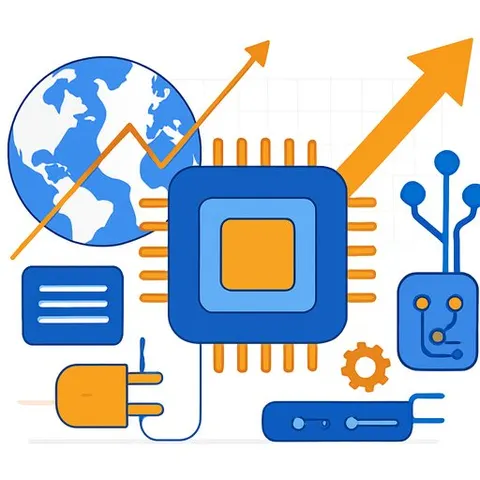
Global semiconductor sales hit $146.8 billion in July 2026, a 6.4% jump from June and the 17th straight month of month-on-month growth, according to the Semiconductor Industry Association. For sales professionals, this isn't just a chip story - it's a map of where budgets, contracts, and infrastructure deals are heading next.
The SIA data uses a three-month moving average, which filters out one-off order spikes and reflects sustained industrial shifts. Second-quarter sales reached $403.3 billion, up 35.1% from the first quarter. The question is no longer whether the AI chip boom will continue, but where it spreads.
Beyond the GPU: five layers of demand
Training and running large AI models requires more than fast processors. Data must move quickly to the chip. Storage must keep pace. Chips must be packaged together efficiently. The entire server needs stable power and cooling. Each bottleneck solved creates a new one downstream, pulling capital and orders outward along the supply chain.
The first obvious beneficiary is memory. High Bandwidth Memory (HBM) has become critical for AI servers, and demand is now reshaping the broader memory market. Reuters reported on September 16 that some small and mid-sized phone and laptop makers are bracing for memory supply shortages that could last years. AI servers absorb high-end production capacity, memory manufacturers adjust their product mix, and even consumer electronics feel the cost pressure.
Advanced packaging is the second layer. As shrinking transistors gets harder and more expensive, connecting chips through advanced packaging has become essential. The question for buyers has shifted from "Can you design it?" to "Can you package it after design?" That demand flows into packaging equipment, substrates, testing tools, and inspection systems.
Semiconductor equipment and materials form the third layer. When chip sales grow, fabs raise capital expenditure. Reuters reported on September 14 that ASML's new High NA EUV equipment - priced around $400 million per unit - is being adopted by TSMC, Samsung, SK Hynix, and Intel. Behind the headline-grabbing lithography machines sits a vast materials market: silicon wafers, photoresist, specialty gases, and high-purity chemicals that directly determine manufacturing yield.
Power, cooling, and the hidden infrastructure
The fourth layer is power supply and heat dissipation. AI servers consume enormous electricity and generate heat that traditional air cooling can't handle. Liquid cooling systems, power modules, cold plates, and coolant distribution units are becoming standard in new data center builds. These components don't produce AI capability, but GPUs can't run without them.
High-speed interconnection is the fifth layer. Modern AI data centers link tens of thousands of GPUs. If network transmission lags behind compute speed, expensive chips sit idle waiting for data. That drives continuous upgrades in optical modules, switches, and high-speed networking gear. Value that was once concentrated in servers is now distributed across chips, memory, networks, power, and cooling.
Where China's supply chain fits
The lengthening industrial chain creates participation points beyond cutting-edge GPU design. Memory requires equipment and materials. Advanced packaging needs substrates and inspection tools. AI servers demand PCBs, power systems, and cooling. Data centers need power distribution, liquid cooling infrastructure, and cabinets.
But industry prosperity doesn't automatically translate to company profits. A firm must clear several gates: inclusion in core customer supply chains, improved product value, higher capacity utilization, stable pricing, and retained margins from new revenue. The spread of AI demand is real, but it rewards specific capabilities, not broad exposure.
Why this matters for sales professionals
The AI hardware cycle is no longer confined to a handful of GPU makers. It is evolving into a large-scale infrastructure upgrade across five layers: computing chips, memory, advanced packaging, equipment and materials, and power/cooling/interconnection. For sales teams in industrial components, data center services, enterprise IT, or AI for Sales software, each layer represents a distinct set of buyers with new budgets and urgent capacity problems. The $146.8 billion figure is a checkpoint. The opportunity lies in understanding which bottleneck your customers are trying to solve next - and being there before your competitors map the same chain. For those building the skills to sell into these sectors, structured AI Learning Path for Sales Representatives can provide the technical fluency that complex infrastructure deals increasingly demand.