
AI news ·
Guillermo del Toro's Cannes outburst captures a growing creative world resistance to AI
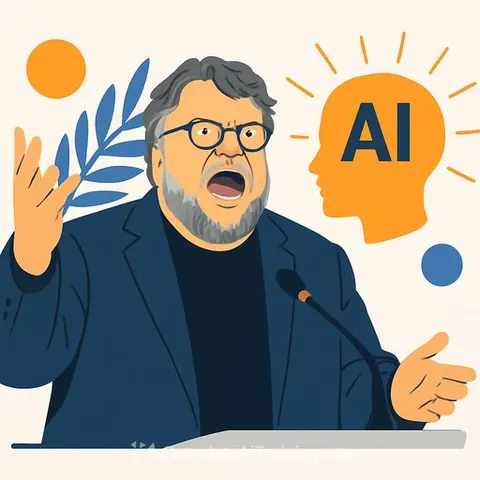
Guillermo del Toro closed his Cannes appearance with "F*** AI" to a standing ovation, reflecting a sharp divide between tech and creative industries. Filmmakers, musicians, and artists argue AI cannot replicate lived experience or genuine emotion.
Hollywood and musicians reject AI as replacement for human creativity
Oscar-winning director Guillermo del Toro ended a public appearance at Cannes this week with two words: "F*** AI." The crowd erupted in applause and a standing ovation.
The moment captured a widening rift between Silicon Valley and the creative world. While technology companies race to embed AI into everything, filmmakers, musicians, writers and artists are increasingly vocal about their resistance-not because of job losses alone, but because they see AI as fundamentally unable to replicate human creativity.
What's driving the pushback
Del Toro's frustration centered on the idea that art can be generated instantly "with a f***ing app." He is far from alone.
During the 2023 Hollywood strikes, writers and actors unions made AI protections a central demand. Since then, major names have gone public with concerns. James Cameron called AI-generated performances "horrifying." Steven Spielberg said he opposes AI "if it replaces a creative individual." Hundreds of actors, directors and artists-including Cate Blanchett, Ben Stiller and Mark Ruffalo-backed a campaign accusing AI companies of exploiting copyrighted work without permission.
The anxiety extends beyond job security. Many artists describe the concern as existential: what happens when machines begin imitating creativity itself?
The musician's perspective
In India, musicians are drawing hard lines. Subir Malik, organist for legendary rock band Parikrama, recently rejected AI-assisted lyrics from a collaborator. "I spent two days writing fresh lyrics instead of using something generated in 30 seconds," he said. "I felt I would be cheating my audience."
Parikrama has made an internal decision: not a single line of lyrics or music in its next 50 songs will be AI-generated.
Music composer Subhajit Mukherjee, a Cannes Lions winner, distinguishes between AI as tool and AI as replacement. "If we are using AI, we should try to use it in a way so that it doesn't affect other people's bread and butter," he said. "As creative people we should trust our heart and brain more than AI."
Singer-songwriter Palash Sen takes a more measured view. He acknowledges AI is a useful tool but argues it lacks lived experience, intuition and emotional depth. "AI's heart has not got broken," he said. "A human emotion cannot be replaced."
Not all creatives agree
The creative world is not monolithic. Filmmaker Shekhar Kapur has embraced AI, building a sci-fi series from the ground up using generative AI. He is also launching an AI film school in Mumbai to put high-tech storytelling tools in the hands of grassroots creators.
Yet even Kapur draws a boundary. "The machine can assist, but it cannot replicate the raw intuition and human spark that actually makes a story resonate," he said.
Actor-director Danish Husain frames the debate differently. The anxiety around AI, he said, goes beyond jobs into philosophy. "Even we do not comprehend completely what makes us human," Husain told NDTV. "But with the scourge of AI we know for certain what does it mean not to be human."
The tech-versus-art divide
Inside technology circles, AI is discussed with excitement and inevitability. Investors pour billions into startups. CEOs describe it as transformative.
The creative world's response is far more conflicted. Creativity has historically been tied to emotion, lived experience, vulnerability and imperfection-qualities that many artists remain unconvinced machines can replicate.
AI may already excel at mimicking human creativity. But judging by the applause that followed del Toro's outburst at Cannes, resistance is no longer quiet.
If you work in creative fields and want to understand how AI tools can assist rather than replace your work, consider exploring AI for Creatives or Generative Art Courses to develop informed perspectives on these tools.