
AI news ·
HR leaders face governance gap as employee-built AI agents multiply unchecked across organisations
Employees are building AI agents faster than companies can track them, and HR leaders are left managing the fallout. Only 13% of organizations have adequate governance, while 57% of workers are feeding sensitive data into unsanctioned tools.
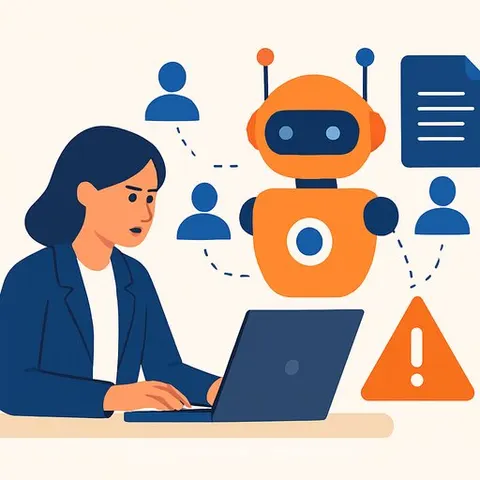
Agent Sprawl: The HR Crisis Companies Aren't Ready For
Companies encouraged their workers to adopt artificial intelligence. That worked. Now they're facing a problem they didn't anticipate: employees are building and deploying AI agents faster than anyone can track them, and the fallout is landing on HR leaders' desks.
At FICO, employees create dozens of new AI agents every day. DaVita has built more than 10,000 agents across its organization. Gartner forecasts that the average Fortune 500 company will run more than 150,000 AI agents by 2028, up from fewer than 15 just a few years ago.
This isn't a technology problem anymore. It's an HR problem.
The Governance Gap
Just 13% of organizations believe they have adequate governance in place to manage AI agents. Meanwhile, 68% of employees are using unsanctioned AI tools, and 57% are feeding sensitive corporate data into them.
The accountability questions are messy. Who owns the output of an AI agent-the employee who built it, the manager who assigned the task, or the company whose data it consumed? What happens when two agents produce conflicting results and a business decision gets made on flawed information? How should performance be evaluated when it's no longer clear how much of an employee's work is their own?
These questions land in HR's lap.
What Employees Actually Think
A Workday survey found that 82% of organizations are rapidly deploying AI agents. But employees are drawing clear boundaries. Three-quarters are comfortable working alongside AI agents. Only 30% are comfortable being managed by them. Fewer than half believe AI agents will become true members of the workforce.
The trend is bottom-up. A Moveworks poll of 200 IT executives at large US companies found that 91% confirmed non-technical, frontline employees are now driving agentic AI initiatives without formal approval or oversight.
A Salesforce survey of chief human resources officers found that 89% believe AI agents will let them reassign employees to new roles, with roughly 23% of the workforce expected to be redeployed. CHROs identified AI literacy as the single most important skill workers will need, with three in four saying AI agents will increase demand for soft skills like collaboration and adaptability.
The Hidden Costs
AI agents consume computing resources every time they process a request. When dozens of employees independently build agents that perform the same task, costs multiply without any corresponding increase in value.
Gartner forecasts that global software spending will surge 15.2% in 2026, reaching $1.43 trillion, with much of that growth driven by AI-related costs that bypass traditional procurement processes. The firm also warns that more than 40% of agentic AI projects will be abandoned by the end of 2027-not because the technology fails, but because of escalating costs, inadequate governance, and an inability to demonstrate business value.
There's another cost researchers are starting to quantify: "workslop." That's the term for low-quality output that results when employees are pressured to produce more, faster, using AI tools that aren't equal to the task. Workers spend an average of nearly two hours cleaning up each instance of substandard AI-generated output they encounter.
What Needs to Happen Now
Blocking or restricting AI agents is not sustainable. Employees who cannot use sanctioned tools will simply reach for unsanctioned ones, creating far greater risks through what's known as "shadow AI."
Gartner outlines a practical framework with six steps:
- Establish clear governance policies that define who can build agents and on what platforms
- Create a centralized inventory of all agents in use
- Manage agent identity and access permissions carefully, with regular reviews to retire redundant bots
- Govern what information agents can access and for how long
- Monitor agent behavior continuously for anomalies
- Build a culture of responsible AI use through training and shared best practices
Some organizations are already moving. DaVita built an internal platform that lets it scale back AI spending when needed while concentrating resources on the highest-performing agents. Lyft developed an IT-approved system for sharing the instruction sets that tell its AI agents how to handle specific tasks, reducing duplication and improving oversight.
The Real Opportunity
For HR departments willing to engage now, the current moment carries genuine opportunity. The organizations best positioned to capture what AI offers are those that start building the governance, literacy, and cultural infrastructure today-before the sprawl becomes unmanageable.
HR professionals should be asking hard questions: Do we have a policy governing which AI tools employees can use and build? Do we know what data those tools are being fed? Are our managers equipped to evaluate work that was partly produced by an agent? Are we prepared for the redeployment and reskilling that will follow?
Learn more about AI for CHROs (Chief Human Resources Officers) to understand how to navigate governance, workforce implications, and strategic deployment of AI agents in your organization.