
AI news ·
China's top tech firms pay AI scientists average of 133,000 yuan a month as talent competition intensifies
China's top tech firms have dropped budget caps for AI talent, with salaries averaging 132,796 yuan monthly. ByteDance, Alibaba, and Tencent are competing fiercely while simultaneously laying off traditional programmers.
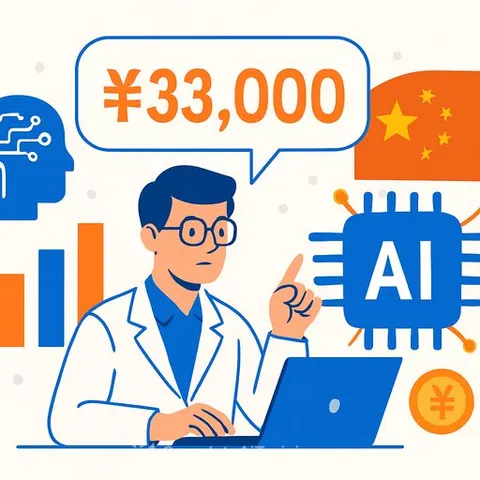
Tech Companies Push AI Salaries Past 130,000 Yuan Monthly as Competition for Talent Intensifies
China's largest tech firms are spending without limits to recruit AI specialists. Alibaba, Tencent, and ByteDance have removed budget caps for AI development talent, according to a recruiter with two decades of experience in the field.
The salary floor has climbed dramatically. AI scientists and team leaders earned an average of 132,796 yuan per month from January through April 2026, nearly double the 74,441 yuan paid to algorithm researchers, the second-ranked position, according to data from Maimai, a professional networking platform.
ByteDance hired Guo Daya, a core contributor to DeepSeek's major AI models, with an annual package in the hundreds of millions of yuan. Both Alibaba and Tencent had competed for him.
Where the Competition Is Heading
In 2023, companies competed mainly for basic model researchers-PhDs from top universities with papers in elite conferences like NeurIPS and ICML. That focus has shifted.
This year, the competition centers on application development talent: people who understand business processes and can embed AI into specific work scenarios. Graduates from 985 and 211 universities-China's second and third tiers of research institutions-have become prime targets, where they weren't before.
The war has spread downward. ByteDance launched global campus recruitment for cutting-edge technologies. Alibaba allocated 50 billion dollars for spring internship recruitment of international students. Tencent announced its 2026 Qingyun Plan internship program with no salary cap.
One Tsinghua doctoral student in computer science said he receives two to three interview calls from major companies each month. A fellow doctoral student received an 800,000 yuan annual salary offer, which he called a "bargain price."
Companies now compete for talent before graduation. Many have launched youth AI and coding courses in Beijing and Shenzhen, with some accepting children as young as six years old.
What Top Talent Actually Wants
Money ranks third on the list of priorities for elite AI researchers. They care most about three things: sufficient computing power and data; a technical direction with real business prospects; and a capable direct supervisor.
Guo Daya chose ByteDance over competitors partly because the company's focus on AI aligned with his expertise in optimization algorithms that improve speed, accuracy, and memory efficiency.
Large companies have responded by creating "zero-resistance" research environments. They've broken with convention to establish internal entrepreneurial zones, grant shares for future pricing power, and offer special treatment. Tencent gave one AI scientist the ability to report directly to the president and appear in internal meetings in casual dress.
The Layoff Paradox
While companies compete fiercely for AI talent, they're also laying off programmers. Social media complaints surface regularly: "Programmers developed AI, but then got laid off themselves."
This reflects a genuine shift in which jobs are vulnerable. Programmers face the most immediate risk. Other occupations don't need to worry about replacement by AI yet, according to Lin Fan, founder and CEO of Maimai.
The flow of displaced programmers moves downward: large companies release top-tier talent, which pushes mid-tier talent to smaller firms, which pushes traditional industry talent out. Each level uses AI tools to improve efficiency, then releases the next tier.
This creates a secondary effect. Historically, only high-margin industries could afford programmers. As AI makes programming faster, programmers shift from expensive specialists to affordable workers available to industries that previously couldn't hire them.
The Rise of the "Super Individual"
Product managers now write programs directly. Designers generate front-end code. Front-end developers write backend code. The traditional job categories are collapsing.
Lin Fan described the dynamic plainly: "Everyone is becoming a super individual. First, encourage the whole team to become super individuals. Those who don't will be eliminated first."
The real competition has moved inside organizations. The structural shortage of AI talent will last at least three more years, he predicted.
Workers Over 35 Get a Second Look
In the mobile internet era, workers over 35 faced layoffs due to perceived energy and adaptability concerns. The AI era changes that calculation.
AI handles tedious work. The industry skills accumulated by older workers-years of domain knowledge-coordinate precisely with AI capabilities. That combination is exactly what companies need to master AI and build new work processes.
For HR professionals managing talent strategy, this means reassessing how experience maps to competitive advantage in an AI-driven workplace.
Learn more about how to navigate AI's impact on talent management with AI for Human Resources or explore strategic insights through the AI Learning Path for CHROs.