
AI news ·
Mercedes-Benz merges HR and IT as German AI adoption rises and unions push for worker participation rights
Mercedes-Benz merged its HR and IT departments on June 5, putting AI Copilot on all 90,000 office desks. German unions are pushing back, demanding a say in AI decisions affecting hiring and promotions.
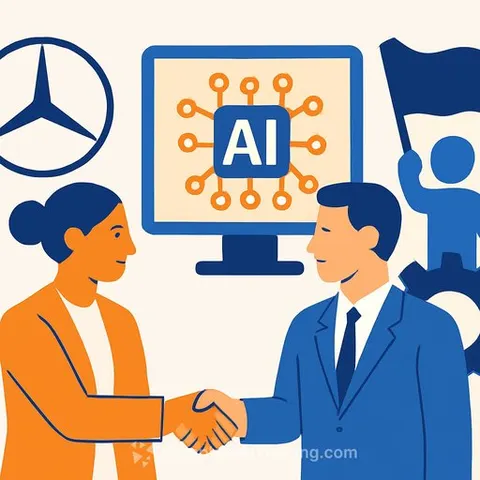
Mercedes-Benz Merges HR and IT as German Companies Race to Deploy AI
Mercedes-Benz announced a major restructuring on June 5 that combines its human resources and IT departments into a single unit called "People & Enterprise Tech," signaling how far companies are willing to go to accelerate AI adoption. Britta Seeger will lead the new division, which previously reported as separate functions to CEO Ola Källenius.
The move reflects a broader shift across German industry. A study by payroll firm SD Worx found that 48 percent of German HR managers now invest in AI, up from 38 percent a year earlier. The payroll department remains the most common entry point, with roughly 40 percent of employers already using AI there.
At Mercedes-Benz specifically, every one of the company's 90,000 office desks has been equipped with Microsoft's AI Copilot. Around 60 percent of office employees now use the tool at least once a week, up sharply from 20 percent earlier. The company aims to reach 70 percent by year-end.
The speed of deployment is outpacing worker input. German unions are pushing back, demanding mandatory participation in AI decisions that affect hiring, promotions, and daily work. The DGB Berlin-Brandenburg cited insufficient worker council involvement in the planned rollout of an AI language model called "LLMoin" in Brandenburg's state administration later this year.
Experts stress that without legally binding participation rights, the technology risks eroding trust among workers. Automated decisions must be transparent and traceable to comply with the EU AI Act, particularly when algorithms influence personnel matters.
Skills Shift Underway
The labor market is already shifting. Demand for junior programmers has fallen sharply, and the number of unemployed computer specialists climbed 25 percent over the past year. Skills like "prompting" - the precise formulation of instructions for AI systems - are increasingly valued over traditional software coding.
Professional associations and chambers of commerce warn that while AI will not eliminate office jobs wholesale, it will fundamentally change how they are performed. Around 45 percent of German companies have redesigned workflows around AI capabilities, and 47 percent have introduced specific guidelines for AI use.
For HR professionals managing this transition, understanding both the technical and regulatory dimensions is critical. AI for Human Resources provides foundational knowledge on how these tools affect workforce management. Those leading organizational strategy should review the AI Learning Path for CHROs, which addresses implementation challenges and worker participation concerns.