
AI news ·
HR professionals risk personal liability for AI employment decisions, attorney warns
HR professionals face personal liability for AI employment violations. A plaintiff recently alleged an AI tool rejected him from more than 100 positions.
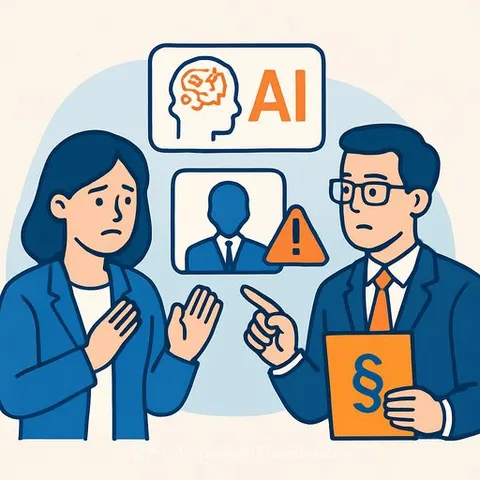
HR professionals who deploy AI tools for hiring, timekeeping, or termination decisions can be held personally liable when those systems violate employment law, according to David Miklas, a Florida-based employment attorney with 27 years of experience advising HR leaders. The risk extends beyond the employer to the individual who configured the tool, approved the vendor, or signed off on the automated decision.
When HR becomes personally liable
Miklas says the liability typically flows from three sources: failure to properly vet an AI vendor before deployment, failure to secure candidate consent where required, and failure to catch or address disparate impacts on protected groups. None of those failures require intent to trigger a claim. Negligence is enough to create exposure.
"The employer will almost always have liability," Miklas said. "And believe it or not, the HR professional may actually have liability personally."
Two federal statutes carry particular weight. The Fair Labor Standards Act (FLSA) and the Family and Medical Leave Act (FMLA) both define "employer" broadly enough to reach individual HR professionals who exercise operational control over employment decisions. "Both of those statutes define employer very broadly to the fact that it can even include a person acting directly or indirectly in the interest of an employer," Miklas said.
In practice, that means an HR professional who configures an AI system to automatically reject intermittent leave requests, or to flag protected medical absences as triggers for termination warnings, can be sued individually for an FMLA violation. The same logic applies to timekeeping. Automated systems that round employee hours or apply deductions based on predicted lunch behavior, rather than actual time worked, can create FLSA wage violations. If an HR professional approved or implemented those settings, personal liability can follow.
The risk extends to layoffs. If an AI tool selects employees for a reduction in force and disproportionately flags workers on FMLA-protected leave, the HR professional who ran that process can be individually named in a lawsuit.
The hiring discrimination risk
AI screening tools can introduce bias at scale, filtering out candidates from protected groups not through deliberate intent but through patterns baked into the underlying data or the way a model was trained. AI hiring tools can pass bias audits and still discriminate by race and role, meaning a clean audit report is not proof of a clean tool.
Some jurisdictions have moved to regulate AI in hiring more specifically. New York City requires independent bias audits before employers can deploy automated decision tools, and failing to conduct one can expose an HR professional to individual liability. A federal judge recently allowed a landmark class action against Workday to proceed, with the plaintiff alleging he was rejected from more than 100 positions at companies using the platform's AI screening tools. The ruling made clear that algorithmic hiring decisions carry real legal consequences.
The consent and confidentiality traps
Miklas flags two additional risk areas that get far less attention. The first is consent. In states with two-party or all-party consent requirements, including Florida, AI note-taking software used in interviews requires affirmative disclosure. If an interviewer does not notify the candidate that AI transcription is active and obtain consent, that can create a violation.
The second issue is confidentiality. Miklas describes a pattern where managers upload confidential performance reviews, personnel records, and sensitive documents into open AI platforms like ChatGPT to speed up routine tasks. If protected information gets uploaded to a public AI tool, an employer's ability to later claim that information was a trade secret or confidential can be seriously undermined. Courts have found that uploading material to an open platform is inconsistent with treating it as confidential. According to a Resume Now survey released in May, more than half of workers are using AI tools their employer hasn't approved, in many cases sharing confidential business information with external systems.
Miklas says every employer with a handbook should have an AI policy in place, and not a vague one. The policy should identify which tools are permitted, what they can be used for, and who to contact with questions. He notes that even the prompts employees enter into AI platforms may be discoverable in litigation.
How HR professionals can protect themselves
Miklas says there are concrete steps HR professionals can take once they understand the risks, starting with one most haven't considered. The first is insurance. Standard general liability and workers' compensation policies don't cover AI-related employment liability, and Miklas says what most HR professionals don't realize is that they may need their own coverage.
The starting point is Employment Practices Liability Insurance (EPLI). Many corporate EPLI policies define "insured" broadly enough to cover HR staff acting within the scope of their duties, but Miklas says professionals should verify that their policy's definition actually includes them, not just the company's directors and officers. One gap worth knowing about is that EPLI typically covers FMLA-related issues but often excludes FLSA wage and hour violations explicitly. That matters because the timekeeping and overtime scenarios Miklas described fall squarely into FLSA territory.
For HR professionals who find their company's EPLI policy doesn't cover them, or whose employer won't purchase one, Miklas recommends looking at errors and omissions insurance. It can be negotiated as part of a compensation package, or secured individually.
The other protection Miklas recommends is a formal corporate indemnification agreement. This is a contractual commitment from the employer to advance defense fees and cover judgments on behalf of the HR professional, provided they acted in good faith. He encourages HR professionals to negotiate such an agreement before taking on any high-risk AI implementation.
Why this matters for HR professionals
The EEOC has made clear that existing anti-discrimination law applies to AI-driven employment decisions. The person who configured the system, approved the vendor, or signed off on the AI-assisted termination can find themselves personally named in a lawsuit. "There are definite risks," Miklas said. "The smartest thing would be for HR to identify these risks. And if the powers that be decide to keep doing it, even if HR isn't comfortable with something, then the backup is to make sure there's coverage that covers those things."