
AI news ·
Illinois schools update bullying policies to cover AI deepfakes as new law takes effect
Starting July 1, Illinois schools must update bullying policies to cover AI-generated deepfakes. A survey found 40% of K-12 students knew of a deepfake at their school.
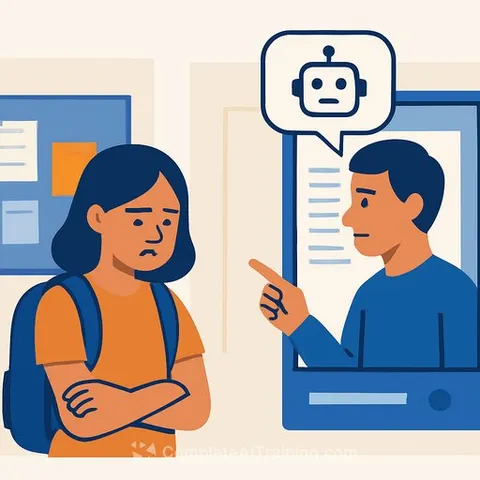
Starting July 1, Illinois school districts must update their bullying prevention policies to address AI-generated content, including sexually explicit deepfakes - a direct response to incidents like the one earlier this year at Lake Zurich High School, where students used artificial intelligence to create harmful images of classmates.
The new law expands the state's definition of cyberbullying to cover unauthorized AI-generated digital replicas. It also requires the Illinois State Board of Education to develop statewide guidance on AI in schools by July 1, with specific direction on false representations of individuals. Districts are expected to incorporate the guidance before the 2026-27 school year.
Lindsay Record, ISBE press secretary, said that while the agency is still developing guidance, "it remains the case that local policies, procedures and responses to specific incidents are determined at the district and school level."
New definition takes effect
Scott Rowe, superintendent of Township High School District 214, said the law gives administrators clearer language for policies, student expectations, and family conversations. "The message is clear," Rowe said. "AI does not remove responsibility."
The legislation does not alter Illinois criminal statutes. AI-generated sexual images that appear to depict minors may still be prosecuted under child pornography and obscenity statutes, with felony charges possible depending on the circumstances.
A 2024 survey from the Center for Democracy & Technology found that 40% of K-12 public school students were aware of a deepfake involving someone at their school, and 15% knew of a sexually explicit deepfake of a school community member. Despite that, more than 60% of teachers reported that their school had not shared any policies or procedures on AI-generated sexual imagery.
State guidance and district response
Lake Zurich Community Unit School District 95, where the earlier incident occurred, plans to continue explicit teaching about safe technology use and keep sharing resources with families. Jean Malek, the district's executive director of communications, said the work aligns with core district values.
Laura Tierney, founder of The Social Institute, said the legal obligation is only part of the solution. "Legislation alone won't solve the spread of this. With legislation has to come education on the topic, and Illinois schools now have a legal obligation to address AI-generated cyberbullying," Tierney said. She added that schools must ask whether they have the curriculum and tools to back the policy. Training resources such as AI for Teachers can help educators integrate these topics into classroom discussion without resorting to scare tactics.
Tierney noted that most students know deepfakes are harmful but may not know how to support peers when images circulate. "It's old school to focus on how harmful it is, like, 'here's all the legal implications.' The reality is that it's still going to happen. So how can we help students make positive choices?"
Challenges of speed, realism, and reach
Rowe said the biggest obstacles for schools are how quickly AI-generated content spreads, how realistic it looks, and how far it reaches. Students may not know an image is fake. And even those who did not create the original content can cause more harm by sharing or forwarding it, which may lead to school or legal consequences.
"AI-generated content may be artificial, but the harm it causes can be very real," Rowe said.
Debra Jacobson, general counsel of the Illinois Association of School Boards, described the situation as "a bit of a game of Whac-A-Mole" because the technology evolves quickly and students are often ahead of adults.
Why this matters for Education
Educators in Illinois - and those watching from other states - are now required not just to prohibit AI-generated bullying but to teach students how to navigate it responsibly. The law creates a formal reason to talk about deepfakes, consent, and online ethics in schools, but the curriculum to carry that out will fall heavily on classroom teachers and district leaders. Without practical classroom strategies, policy alone will not close the gap.