
AI news ·
Insurers explore AI to model wildfire risks and process claims
Wildfires in Spain and France threaten billions of dollars in insurance losses. Insurers are using AI to improve risk models and speed up claims.
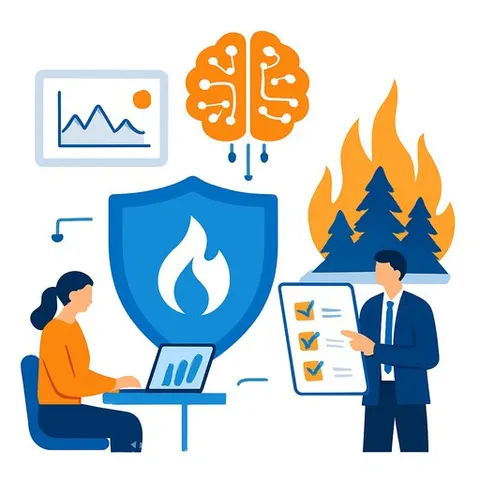
Wildfires sweeping across Spain and France are creating billions of dollars in potential insurance losses, with authorities warning that extreme heat, dry conditions and strong winds are fueling rapid fire spread. According to reporting from Sky News, the situation shows no sign of improving, pushing insurers to search for new tools to manage a risk that traditional models are struggling to forecast.
Sharper risk modeling for individual properties
Large-scale wildfires overwhelm insurers because they generate thousands of claims simultaneously, disrupting entire regions and introducing long-term uncertainty about future exposure. Historical data-long the backbone of underwriting-becomes less reliable when weather patterns themselves appear to be shifting. In response, some insurers are turning to AI-driven analytics to process enormous datasets: satellite imagery, weather forecasts, vegetation maps, topography, and decades of fire history.
These techniques, taught in AI for Insurance Courses & Certifications, allow insurers to move beyond zip-code-level risk and assess individual properties with greater precision. AI won't predict exactly where the next wildfire will ignite-that remains notoriously difficult-but it can highlight areas where risk is climbing, helping underwriters adjust pricing and exposure before a catastrophe hits.
Faster claims processing when disasters hit
After a major wildfire, claims departments face a deluge of cases that can delay payouts by weeks or months. Some insurers are testing AI systems that automate parts of the process, analyzing photographs, satellite images, and damage reports to prioritize cases and speed up assessments. During the 2025 California fires, for instance, claims teams became overwhelmed, highlighting the need for tools that can handle volume without sacrificing accuracy.
Human adjusters remain essential for evaluating complex losses, but AI can cut the administrative load dramatically. Policyholders get faster responses, and insurers process claims more efficiently-no small advantage when public scrutiny is high and every day of delay erodes trust.
Early detection to limit fire damage
Technology firms are developing AI systems that use sensors, drones, and satellite imagery to detect wildfires earlier than ground-based lookouts ever could. Faster detection means quicker response from emergency services, which in theory reduces the severity of the event. For insurers, even a modest reduction in wildfire intensity could translate into substantial financial savings across a portfolio of policies.
The challenge is that wildfire behavior depends on countless variables-wind shifts, terrain, human activity-that even advanced AI struggles to model. Recent fires in Spain and France escalated rapidly despite extensive monitoring, proving that early detection alone won't eliminate the risk. But for insurers, incremental improvements matter. A fire that's contained at 50 acres instead of 5000 is a fire that doesn't trigger a solvency event.
Why this matters for insurance professionals
Integrating AI into underwriting, claims, and risk assessment is already moving from pilot projects to production. Professionals who understand how to apply machine learning to wildfire risk-whether through finer-grained pricing, automated claims triage, or early-detection data feeds-will be positioned to reduce loss ratios and improve customer outcomes. As wildfire seasons intensify across the globe, the technology won't replace human judgment, but ignoring it could leave portfolios dangerously exposed.