
AI news ·
Insurers risk accumulating AI debt without a unified enterprise strategy, Capgemini warns
Insurance firms running disconnected AI pilots are accumulating costs, not value. A unified strategy-auditing roles, rebuilding workflows, and sharing governance-separates leaders from those left behind.
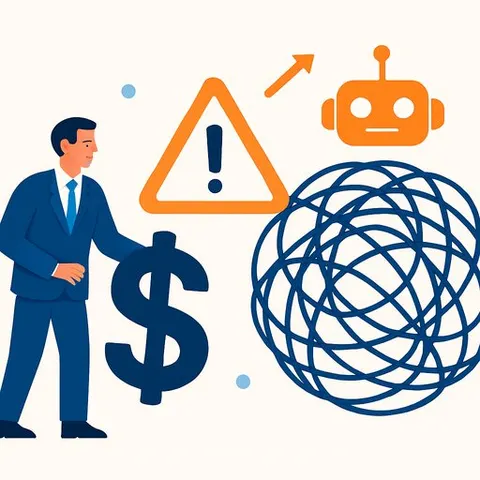
Insurance firms face a choice: unify AI strategy or accumulate debt
Insurance companies are deploying AI faster than they can manage it. Most are discovering that scattered experiments don't produce real transformation-they produce operational risk.
Underwriting teams pilot document summarisation. Claims departments test automation. IT evaluates enterprise licences. Business intelligence deploys new models. Without a single strategy connecting these efforts, the result is what the industry calls "pilot purgatory": multiple licences for the same tools, similar tasks performed by different systems, and pilots that stay confined to their own departments.
The problem runs deeper than inefficiency. When each team optimises for its own needs, integration work expands, governance grows, and vendor management increases. Total costs rise even when individual use cases show decent returns. Meanwhile, competitors adopting integrated AI models begin to move ahead.
Why layering AI onto old processes fails
Many insurers are applying AI to existing workflows without rethinking those workflows at all. An underwriter still follows the same steps-just faster. A claims processor still performs the same tasks-just with less manual data entry.
This approach misses the point. When an AI system can summarise a 200-page medical report in minutes, the constraint isn't speed anymore. The opportunity is to shift what humans spend time on. An underwriter could move from data retrieval to analysing complex risk. A claims professional could focus on managing exceptions and maintaining contact with beneficiaries.
The Industrial Revolution offers a parallel. Manufacturers didn't simply make machines perform old tasks faster. They reorganised production around new capabilities. Roles changed. Workflows were rebuilt. Assembly lines were redesigned.
Insurance is at the same inflection point. Without reimagining processes around AI's capabilities, organisations simply digitise their legacy operating model. They may reduce costs in the short term but limit their capacity to innovate.
Three steps to building AI-first operations
Step 1: Audit roles, tasks, and departments. Before selecting technology, map how each role functions today and envision how it could work with AI. Where is time spent? Where does friction exist? Which activities directly influence performance metrics?
The audit should answer four questions:
- Where can efficiencies be created?
- Which activities could be done more efficiently?
- Which activities could become more valuable?
- Where must a human stay in the loop?
Manual data entry and repetitive document review typically decrease as AI handles large volumes of information. But other responsibilities grow in importance: monitoring outputs, managing edge cases, escalating risk, and applying professional judgement. Work that requires empathy, communication, and contextual judgement-particularly in claims where policyholders navigate sensitive events-remains fundamentally human.
Step 2: Reverse-engineer workflows. Once the future state is defined, rebuild microprocesses across intake, underwriting, fraud review, claims adjudication, and customer communication.
Not every task requires generative AI. Existing fraud models still matter. Robotic Process Automation handles structured tasks like data transfer and rule-based processing. Machine learning supports scoring and detection. Large language models summarise unstructured content. The goal is connecting capabilities, not using one tool to replace everything else.
Medical intake for a claim might combine document extraction using language models, cross-validation through AI agents, and existing fraud scoring models, with a human making the final decision. AI is part of a coordinated toolset.
Step 3: Align on an organisational strategy. Establish a unified platform that provides the foundation for reusable agents, multiple language models, shared governance, and opportunities to share lessons across departments. As use cases mature, an orchestration platform enables cross-pollination between underwriting, claims, new business, and billing teams.
This requires interoperability with existing systems, governance capabilities, data security requirements, and support for multiple AI approaches simultaneously.
The cost of standing still
Separate teams licensing the same tools. Cybersecurity exposure expanding as more systems access sensitive data. IT capacity absorbed by maintaining multiple pilots. Hard-earned lessons benefiting only those who experienced them. Technology costs soaring. ROI nowhere near projected.
Meanwhile, AI investment is becoming table stakes across the industry. Clients and distribution partners increasingly expect insurers to use AI to improve responsiveness, accuracy, and decision making. Organisations lagging behind risk falling out of step with rising expectations across the value chain.
Insurers tied to manual processes and disconnected pilots may achieve lower operating costs in the short term. But they forfeit the larger opportunity: shifting time to higher-value work. When AI handles routine document analysis, teams focus on product innovation and developing new policy structures for emerging customer needs.
Building sustainable capabilities
Investment in AI alone doesn't create transformation. Without an enterprise strategy and a clear AI-first operating model, experimentation generates debt instead of value.
Building advanced AI capabilities in-house grows increasingly difficult. Technologies, tools, and architectures evolve rapidly. Maintaining expertise across language models, AI agents, machine learning, governance frameworks, and enterprise integration requires continuous investment and exposure to real-world implementations.
Strategic partnerships provide flexibility internal teams struggle to achieve. External partners with deep specialist benches can scale expertise up or down as needed, bringing the right capabilities to each transformation stage while helping firms avoid costly missteps.
Across the industry, AI implementation is already underway. The question is which insurers will lead that shift-and which will be left trailing.
Learn more about AI for Insurance and AI Agents & Automation to understand how these technologies reshape insurance operations.