
AI news ·
Military leaders urge caution on AI targeting even as Pentagon expands its use
Senior military commanders are pushing back on the Pentagon's rapid AI expansion, raising concerns about autonomous strike decisions. Adm. Frank Bradley warned humans must ensure AI "delivers violence only where we intend."
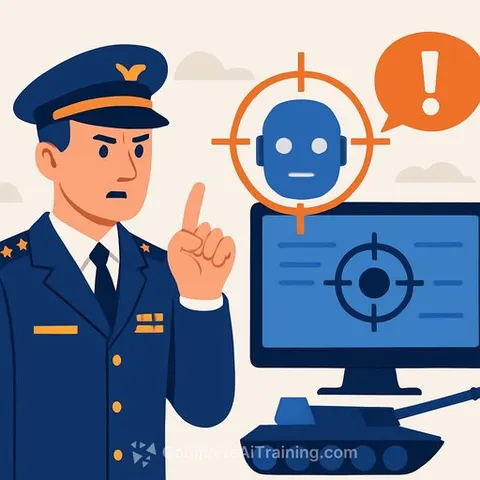
Military Leaders Push Back on Pentagon's AI Expansion
The Department of War is accelerating its AI adoption across operations, but senior military commanders are raising concerns about how the technology will be deployed in combat situations.
Adm. Frank Bradley, head of U.S. Special Operations Command, said during a recent conference that the military must be careful about AI's role in delivering strikes. "We, as humans, have to have the confidence that … it's going to deliver violence only where we intend it to be delivered," Bradley said, even as he acknowledged AI could help identify targets.
Bradley oversees the units responsible for the military's most sensitive and complex operations.
The Pentagon's AI-First Strategy
Secretary of War Pete Hegseth has made AI development a top priority. In May, the department announced deals with SpaceX, OpenAI, Oracle, Google, Nvidia, Reflection, Microsoft, and Amazon Web Services to access their platforms in classified settings.
Hegseth told Congress in late April that AI integration across all operations will give the military a speed advantage over adversaries. "If we're better at that than any adversary is, it's going to give us an advantage, and we have to maintain that," he said.
The department is also pursuing unclassified applications. Melissa Johnson, the top acquisition official for Special Operations Command, said AI should reduce the cognitive burden of routine administrative work. Sgt. Maj. Andrew Krogman, SOCOM's top enlisted official, agreed that AI handles administrative tasks well.
Control and Oversight Questions
A dispute between the Pentagon and AI company Anthropic has highlighted tensions over who controls military AI systems. The department designated Anthropic as a supply chain risk and sued over concerns that the Pentagon might use Claude for mass surveillance and fully autonomous armed drones.
Anthropic has continued engaging with the administration despite the pending litigation.
The question of whether private AI companies or the military should direct the software remains unresolved. For operations professionals, understanding AI for Operations and how AI Agents & Automation fit into military workflows will be critical as these systems expand.