
AI news ·
New Zealand plans to cut 14 percent of public service jobs as government mandates AI adoption across all agencies
New Zealand will cut roughly 9,000 public sector jobs - 14% of its government workforce - as it moves to deploy AI across all agencies. The restructuring is expected to save NZ$2.4 billion over four years.
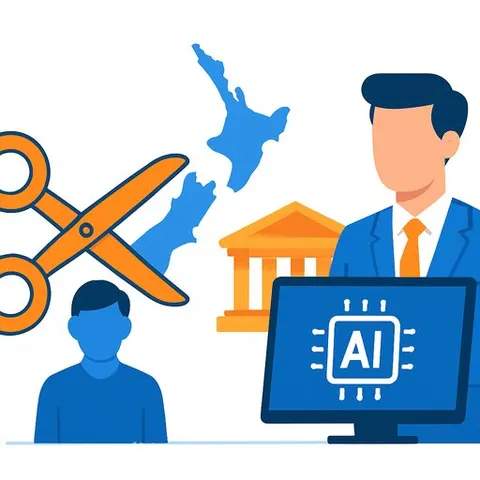
New Zealand plans to cut 14% of government workforce through AI deployment
New Zealand's Finance Minister Nicola Willis announced yesterday that the government will lay off approximately 9,000 public sector workers - about 14 percent of current staff - as part of a broader push to adopt AI across government agencies.
Willis characterized New Zealand's public service as fragmented and slow to embrace technology. She noted the country operates 39 separate departments and ministries, compared to 16 in Australia and 24 in the UK, and said the government is "scared of AI, slow to move to the cloud" with "complex and overlapping IT solutions."
The overhaul will task the Chief Digital Officer with embedding AI deployment as a standard expectation across all public entities. Willis cited a trial of an AI scribe tool in hospital emergency rooms that reduced administrative time for clinicians and increased patient contact as a model for expansion.
The government expects the combination of redundancies and budget caps to save NZ$2.4 billion (US$1.4 billion) over four years - less than one percent of total core government spending.
Broader trend in public and private sectors
Major technology companies including Cisco, Cloudflare, Atlassian, and Meta have justified significant layoffs as necessary workforce restructuring for an AI-driven environment. Few governments have pursued similar cuts, though the U.S. Department of Government Efficiency under Elon Musk attempted a comparable approach with limited documented success.
New Zealand faces distinct constraints. The country has a modest tax base but residents expect high-level government services, making this a substantial bet on AI's ability to deliver efficiency gains.
Government employees should understand how AI will shape policy decisions and implementation strategy, particularly as agencies begin deployment at scale. For broader context on AI adoption in government, resources are available for those navigating organizational change.