
AI news ·
Physical AI moves from screen to real world as robots and autonomous systems advance
Physical AI systems - robots, drones, and autonomous vehicles that sense and act in the real world - are already working factory floors. But experts say full mainstream adoption is still two to three years away.
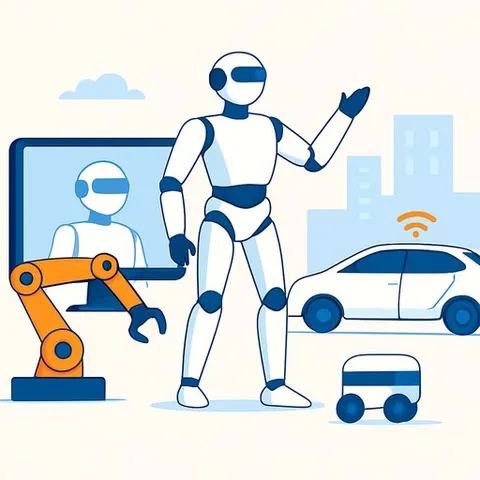
Physical AI Is Already Operating in Factories. Here's What Experts Say Comes Next
A humanoid robot in Shenzhen recently moonwalked across a stage to Michael Jackson's "Billie Jean," executing precise heel pivots before stumbling on a set of stairs. The video circulated widely on social media this week, offering a glimpse of what many researchers now call the next phase of artificial intelligence: physical AI.
Physical AI refers to any system designed to interact with the real world through sensors and actuators, rather than existing only in software. It extends beyond humanoid robots to include medical devices, autonomous vehicles, smart manufacturing systems, and drones.
What makes physical AI different
The term "physical AI" gained prominence through Jensen Huang, CEO of NVIDIA, who suggested that the "ChatGPT moment for general robotics is just around the corner."
Physical AI systems must perform three core functions: perceive their environment, reason about what they perceive, and act on that reasoning. Unlike traditional industrial robots programmed to repeat fixed motions, these systems learn and adapt to changing conditions.
Reasoning in physical AI systems relies heavily on language models. These systems understand descriptions and patterns, then translate that understanding into physical action. Sarah Ostadabbas, associate professor of electrical and computer engineering at Northeastern University, said the reasoning component "is really important" to bridge the gap between virtual training and real-world operation.
An emerging template is the "vision-language-action" model, which combines visual perception and language processing. Early examples include NVIDIA's GR00T N1 and Google DeepMind's RT-1, both designed to help robots interpret surroundings and execute complex tasks.
Current applications in industry
Physical AI is already deployed in manufacturing. Robotic arms assemble products on factory lines, while autonomous warehouse robots transport inventory and sort packages with minimal human oversight.
Unlike their predecessors, these systems can operate in less predictable environments. They identify objects, navigate spaces independently, and adjust to shifting conditions-capabilities that could reshape how factories operate.
Significant hurdles remain
Physical AI remains largely theoretical. The real world presents challenges that controlled training environments do not: visual and physical data is often "unclean" or "dirty," containing obstacles and unexpected variables.
Safety poses another barrier. Systems operating near people must avoid harm and earn trust, raising technical and legal questions. Ostadabbas said developers must ensure actions are "safe, trustworthy, verifiable and robust."
Yanzhi Wang, professor of electrical and computer engineering, believes large-scale implementation may arrive soon. "I think it will become more mainstream, but it is still a far way to go," Wang said. "Based on the current progress of this generation of tools, maybe after two or three years there will be a big breakthrough."
At Northeastern University's Physical AI Research Initiative, researchers are establishing frameworks to guide development. The work reflects a broader recognition that moving AI from screens into the physical world requires solving problems that simulations alone cannot address.
Learn more about AI Agents & Automation and the role of Generative AI and LLM in enabling these systems.