
AI news ·
Pope Leo XIV calls for educational alliance to protect young people from harms of AI
Pope Leo XIV's encyclical "Magnifica Humanitas" urges teachers and policymakers to form an "educational alliance" shielding students from AI tools that replace thinking. He warns that instant AI-generated answers risk killing students' curiosity.
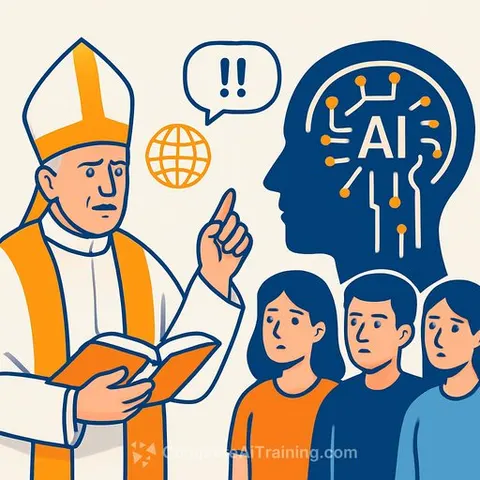
Pope Leo XIV calls on educators to protect students from AI's educational pitfalls
Pope Leo XIV released an encyclical this week urging teachers, parents and policymakers to form an "educational alliance for the digital age" to safeguard young people's intellectual development as artificial intelligence expands into schools and homes.
The document, titled "Magnifica Humanitas," addresses what the pope identifies as a fundamental problem: "Rapid technological transformations reveal just how unprepared we are on the educational level."
The problem: Speed over understanding
Digital media fosters "a culture of immediacy and hyper-stimulation," the pope wrote, creating "fatigue, boredom and apathy concerning the effort required for seeking the truth." Education, by contrast, demands patience and time.
He highlighted a specific risk with AI tools: "The speed and ease with which answers or summaries can be obtained risk extinguishing the desire to ask questions." When students can generate perfect essays or summaries instantly, they may stop thinking critically about material.
Luke Rowe, a lecturer at Australian Catholic University who teaches learning science and evidence-based instruction, said the encyclical's emphasis on human imperfection resonated deeply. "Everything's now neat and polished. We have perfect grammar because we're writing with AI on our emails," he said. "The synthetic world is starting to erase human imperfections."
Rowe stressed that educators need to help students understand the difference between AI-generated perfection and genuine learning. "Students need to be able to think for themselves before they start to defer to technology to do the thinking for them," he said.
What teachers should do: Teach students when not to use AI
The encyclical doesn't call for banning AI from schools. Instead, it urges educators to teach students "to decide when and for what purpose it ought not to be used."
Kathy Ann Mills, a researcher in digital and media practices at Australian Catholic University, said teachers play a critical role in helping students understand AI's limitations and biases. Children naturally anthropomorphize AI-treating it as human-like-especially when it has a face or persona, she noted. Teachers must guide students to recognize when AI systems are misleading or contain embedded biases.
Even young students can learn to identify bias in AI outputs, Mills said. They can ask: "Whose voices are missing? Whose views dominate? Who benefits from this technology?"
For parents: The burden shouldn't fall on families alone
The pope acknowledged that parents cannot single-handedly resist business models designed to capture children's attention and time. He called for "far-sighted public policies" that protect minors' wellbeing even when those policies conflict with platform interests.
The encyclical warns that unsupervised digital exposure harms sleep, attention spans and emotional regulation. It can also expose children to cyberbullying, online exploitation and manipulation by AI systems.
The pope urged legislators to set age limits, hold service providers accountable, and provide specific protections against online sexual exploitation-rather than shifting all responsibility to families.
For schools: Rethink structure and teacher support
Schools must rethink physical spaces, evaluation methods and the teacher's role to promote "authentically integral education," the pope wrote. This means education that addresses the whole person, not just information delivery.
Teachers themselves need ongoing support and professional development to engage with new technologies while helping students use them responsibly and creatively. Many educators already report signs of what the pope called "dehumanization"-students who "know many things" but struggle to find direction or connect information to deeper knowledge.
Rowe emphasized the sacred dimension of learning. "There's something sacred in how teachers and students interact when they build knowledge together," he said.
The core message: Protect human dignity in learning
The encyclical contrasts how machines and humans handle error. "For an algorithm, an error is a flaw to be corrected; for a person, however, an error can be a catalyst for profound change," the pope wrote.
Schools are called to "offer that which the digital sphere by itself cannot provide, namely a shared time for learning and developing trustworthy relationships." They are "not called to follow the pace of the digital world."
For educators seeking guidance on implementing these principles, resources on AI for Education and the AI Learning Path for Teachers offer practical frameworks for responsible technology use in the classroom.
The pope's message to educators is direct: protect students from the temptation to outsource thinking to machines. Teach them to value their own imperfections. Help them recognize when AI serves learning and when it undermines it. And create spaces where human connection and intellectual growth still matter.