
AI news ·
Pope Leo XIV calls for human oversight of AI in education, work and data use
Pope Leo XIV's encyclical Magnifica Humanitas calls for human oversight of AI in schools, workplaces, and public services. It warns that automated systems can concentrate power and deepen exclusion without clear accountability.
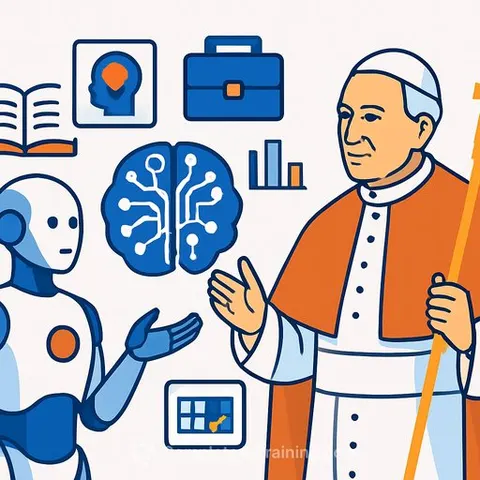
Pope Leo XIV calls for human oversight of AI in schools and workplaces
Pope Leo XIV has published Magnifica Humanitas, an encyclical on artificial intelligence that demands stronger governance, transparent accountability, and human-centered use of digital technologies across education, employment, and public services.
The document does not reject AI. Instead, it treats technology as a tool requiring oversight rather than a neutral force outside human responsibility. The encyclical warns that digital systems can concentrate power, shape access to opportunities, and deepen exclusion when decisions are made without public accountability.
What schools and teachers need to do
Magnifica Humanitas places education at the center of AI governance. Schools must teach students when AI should and should not be used, the encyclical says.
Teachers need ongoing professional training to help students use new technologies responsibly and critically, rather than passively accepting what algorithms produce. The document warns that fast AI answers risk weakening the habit of asking questions.
Pope Leo XIV said: "It is necessary to support the ongoing formation of teachers throughout their professional lives, so that they can engage positively with new technologies, helping students to use them responsibly, critically and creatively, rather than passively succumbing to their influence."
Schools should also protect children online through age limits, service provider accountability, and protection against exploitation, cyberbullying, and AI-enabled image manipulation.
For educators looking to build these skills, AI Learning Path for Teachers offers structured guidance on integrating AI responsibly into classrooms. The AI for Education resource covers governance and student safety frameworks relevant to the encyclical's priorities.
Control and accountability matter more than neutrality
The encyclical states: "Technology is never neutral, because it takes on the characteristics of those who devise, finance, regulate and use it."
Control over platforms, infrastructure, data, and computing power often sits with major technology companies rather than governments or public institutions. Those companies set access conditions, visibility rules, and participation pathways across digital environments.
Magnifica Humanitas calls for clearer responsibility across the entire AI chain-from designers and trainers to those using systems in decisions affecting people's lives. Accountability must include identifying who made a decision, justifying it, monitoring outcomes, challenging errors, and remedying harm.
The encyclical warns against reducing AI ethics to machine alignment alone. Ethical frameworks themselves must be open to scrutiny, rather than set by a small number of technology owners.
Employment and data extraction
AI is already embedded in decision-making across employment, credit, reputation, and public services. Automated systems can create new forms of exclusion when people cannot understand or appeal decisions made about them.
While automation could relieve workers of arduous or dangerous tasks, the encyclical warns against using technology mainly to reduce labor costs. Pope Leo XIV said: "While AI promises to boost productivity by taking over mundane tasks, it frequently forces workers to adapt to the speed and demands of machines, rather than machines being designed to support those who work."
The document calls for social criteria for innovation, including protections for employment, retraining, and worker participation when automation is introduced.
Magnifica Humanitas also addresses data extraction. AI systems rely on unseen workers involved in data labeling, model training, and content moderation. Data collected through aid, research, or innovation can become a new form of extraction when individuals and communities lose control over how it is used.
Pope Leo XIV wrote: "Data is the product of many contributors and should not be treated as something to be sold off or entrusted to a select few."
What AI systems cannot do
The encyclical distinguishes between computational speed and human judgment. AI systems imitate functions of human intelligence but lack human experience, bodily life, moral conscience, or understanding.
Pope Leo XIV said: "So-called artificial intelligences do not undergo experiences, do not possess a body, do not feel joy or pain, do not mature through relationships and do not know from within what love, work, friendship or responsibility mean."
The document also extends its concerns to autonomous weapons, cyberattacks, and influence campaigns. Lethal force must not be delegated to opaque or automated processes, and international rules should curb the technology arms race and protect civilians.
Who bears responsibility
Magnifica Humanitas closes by naming who must act: researchers, technology companies, schools, media institutions, and local communities. The digital era should not be left to technological inevitability, the Pope said.