
AI news ·
Pope Leo XIV's AI encyclical puts HR professionals on notice over workforce displacement
Pope Leo XIV's 42,300-word encyclical on AI and labor directly challenges how companies use automated tools in hiring and workforce decisions. Released May 15, it warns that chasing profits cannot justify choices that "systematically sacrifice jobs."
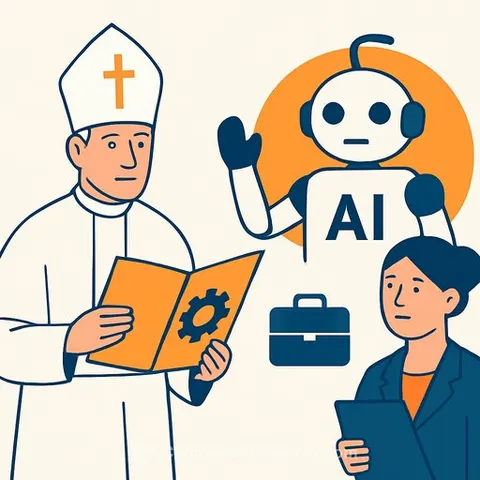
Pope Leo XIV's Encyclical on AI Puts HR Compliance and Ethics in Sharp Focus
Pope Leo XIV released Magnifica Humanitas on May 15, a 42,300-word encyclical addressing artificial intelligence and labor. The document, signed on the 135th anniversary of the papal letter Rerum Novarum, directly challenges how companies use AI in hiring, performance management, and workforce planning. "The pursuit of greater profits cannot justify choices that systematically sacrifice jobs," Leo wrote. The Pope, born Robert Prevost in Chicago and the first American pope, delivered the encyclical alongside Christopher Olah, a co-founder of Anthropic, at the Vatican.
The timing carries weight. The AI companies reshaping the global economy are concentrated in Northern California, yet their tools are embedded in HR systems across every industry in the United States.
The Numbers Behind the Concern
Tech companies shed more than 95,000 jobs across 247 separate layoff events in the first months of 2026 - an average of 882 positions per day. Amazon eliminated 16,000 corporate roles in January. Oracle cut an estimated 30,000 employees in March. Meta reduced its workforce by 10 percent while reporting record revenues.
Goldman Sachs estimates that 6 to 7 percent of US workers - roughly 11 million people - could ultimately see their jobs displaced by AI. A survey found that 30 percent of companies planned to replace employees with AI in 2026 alone, after 21 percent had already done so in the previous year. Nearly half of those employers said between 10 and 45 percent of their current workforce would be affected.
What the Encyclical Says About HR Practice
Leo's framework maps directly onto decisions HR teams are making about responsible AI adoption. The Pope explicitly condemns what he calls "de-skilling" - the pattern in which AI systems force workers to adapt to machine speed rather than machines being designed to support workers. The result can "paradoxically de-skill workers, subject them to automated surveillance and relegate them to rigid and repetitive tasks."
Research shows this dynamic is already present in major corporations. Firms using connected workforce intelligence systems are up to 11 times more likely to describe their workforce as highly adaptable - but that adaptability requires investment in people, not just platforms. HR professionals are sometimes inadvertently building the systems that generate this pressure.
The encyclical addresses data governance in terms with direct HR application. Data ownership "cannot be left solely in private hands but must be appropriately regulated," Leo writes. "Data is the product of many contributors and should not be treated as something to be sold off or entrusted to a select few."
For HR teams, this is not abstract theology. It describes the compliance exposure that state-level AI employment laws already address. As of early 2026, 19 of the most populous states had enacted such policies. A 2026 report from the Society for Human Resource Management found that 57 percent of HR professionals in those states were unaware of the relevant policies - a significant compliance gap.
Industry Acknowledges Its Own Constraints
Olah offered a direct acknowledgement of the AI industry's limitations. Every frontier AI lab, including Anthropic, "operates inside a set of incentives and constraints that can sometimes conflict with doing the right thing," he said at the Vatican presentation.
He called for external voices. "If we want this technology to go well, it is enormously important that there be people outside those incentives - people who care about things going well and insist on safety, who are paying close attention, who are willing to say hard things," Olah said. "We need moral voices that the incentives cannot bend."
The Role HR Must Play
HR leaders control the adoption of AI in hiring, performance evaluation, and workforce planning. The question is whether they will establish ethical guardrails before external pressure forces the issue.
For HR professionals navigating this terrain, understanding both the Pope's framework and the emerging state regulations is essential. AI for Human Resources covers the practical dimensions of responsible adoption. For executives setting strategy, the AI Learning Path for CHROs addresses how to build systems that serve workers rather than simply replace them.
The encyclical's core argument is straightforward: technology is not the question. How power over that technology is distributed, and whether workers are treated as ends or means, is.